Last reviewed: May 13, 2026. Platform specs, ad policies, and creative tools can change; verify final requirements inside Ads Manager before launch.
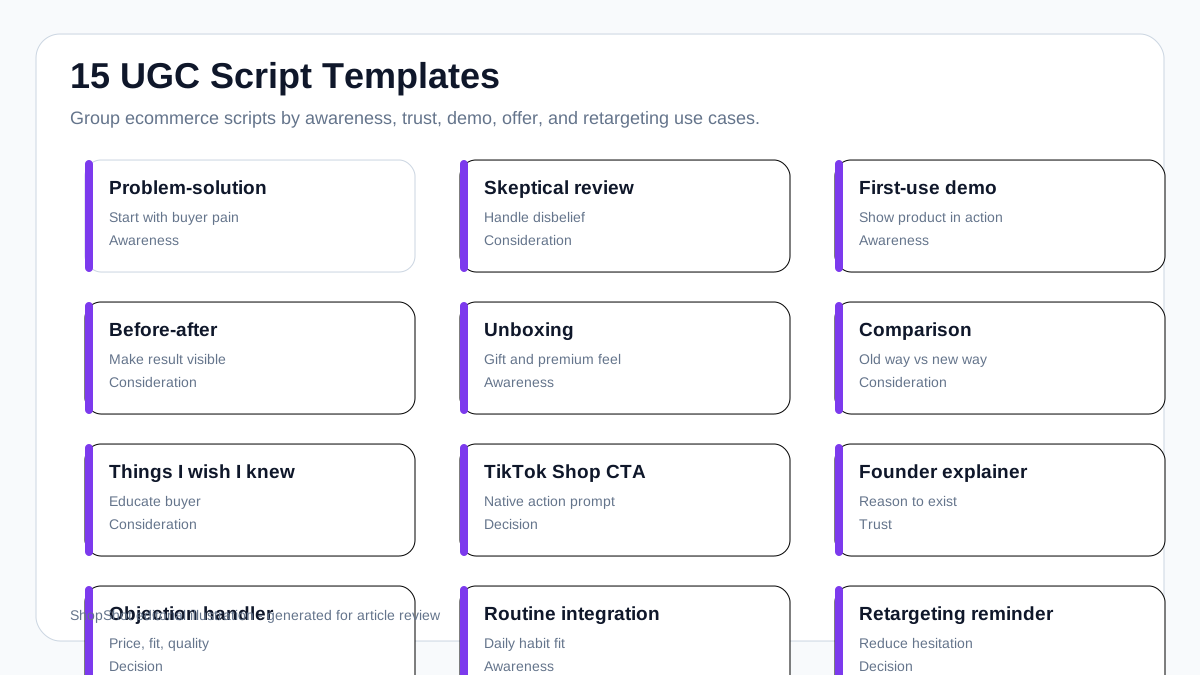
Good UGC scripts do not sound like polished commercials. They sound like a real person found a product, understood the buyer's problem, tested it, and explained the result quickly.
For ecommerce product ads, a UGC script has one job: make the viewer believe the product is relevant enough to keep watching, then clear enough to click.
Use these 15 UGC script templates for TikTok, Instagram Reels, YouTube Shorts, Meta ads, product launch videos, and retargeting creatives. You can give them to a creator, record them yourself, or use them as input for an AI product video workflow.
If you need voiceover options, read Compare AI Voiceover Options in UGC Video Tools. If you are comparing production approaches, start with Best UGC Video Tools for Social Ads and Ecommerce Video Ads.
Quick Answer
A strong UGC product ad script usually has five parts:
- Hook: One sentence that names the problem, result, or curiosity.
- Context: Who the product is for.
- Product moment: Show or describe the product in use.
- Proof: Review, test, before/after, comparison, or objection answer.
- CTA: One clear next step.
Do not start with your brand story. Start with the buyer's situation.
UGC Script Formula
Hook: "If you [problem], this is worth seeing."
Context: "I tried it because [reason]."
Product moment: "Here is how it works."
Proof: "The difference was [specific result]."
CTA: "You can check it out here."
This formula works because it mirrors how buyers think:
- Do I have this problem?
- Is this product for me?
- Does it actually work?
- What should I do next?
30-Second UGC Product Ad Timeline
High-ranking UGC script template pages usually give copy blocks. Ecommerce teams need one more layer: timing. A script that reads well can still fail if the product appears too late or the proof is buried.
Use this timeline when writing UGC scripts for TikTok, Instagram Reels, YouTube Shorts, or Meta ads.
| Time | Script Job | Visual Job | Common Mistake |
|---|---|---|---|
| 0-3s | Hook the problem, result, or curiosity | Show face, product, result, or problem scene | Starting with brand name or long intro |
| 3-8s | Give context: who this is for | Show the product close to the use case | Talking about features before relevance |
| 8-18s | Demo the product or explain the mechanism | Show hands, product use, before/after, or comparison | Hiding the actual product |
| 18-25s | Add proof or objection answer | Show review, detail close-up, result, or side-by-side | Making a claim without support |
| 25-30s | Give one CTA | Show product hero, landing page, shop button, or offer | Adding multiple CTAs |
For a 15-second ad, compress the same structure:
0-2s: Hook
2-6s: Product use
6-11s: Proof or result
11-15s: CTA
The first 3 seconds do not need to explain everything. They need to make the right buyer stay long enough to see the product moment.
UGC Script Inputs Before You Write
The best scripts come from product-specific inputs, not generic hook formulas. Before writing, collect:
| Input | Why It Matters | Example |
|---|---|---|
| Buyer problem | Makes the hook feel relevant | "My desk looks clean for one hour, then cables take over again." |
| Visible product moment | Gives the video something to show | Drawer before/after, cream application, outfit stretch test |
| Proof type | Makes the claim believable | Review, comparison, test period, material detail, demo result |
| Main objection | Makes the script useful for retargeting | "Will it fit?" "Does it feel cheap?" "Is setup annoying?" |
| Platform | Changes pacing and CTA style | TikTok Shop, Instagram Reels, YouTube Shorts, Meta Feed |
| Claim limits | Reduces policy and trust risk | Avoid medical, financial, unrealistic body, or guaranteed-result claims |
If you use an AI writing tool, paste these inputs before asking for hooks. Without them, the model will usually produce polished but interchangeable ad copy.
15 UGC Script Templates for Product Ads
| # | Template | Best For | Buyer Stage |
|---|---|---|---|
| 1 | Problem-solution | Broad ecommerce products | Awareness |
| 2 | "I was skeptical" review | High-objection products | Consideration |
| 3 | First-use demo | Gadgets, beauty, home | Awareness |
| 4 | Before-after | Beauty, cleaning, fitness, organization | Consideration |
| 5 | Unboxing | Giftable or premium products | Awareness |
| 6 | Comparison | Alternatives, upgrades | Consideration |
| 7 | "Things I wish I knew" | Education-heavy products | Consideration |
| 8 | TikTok Shop CTA | TikTok Shop products | Decision |
| 9 | Founder-style explainer | New brands | Trust |
| 10 | Objection handler | Price, quality, fit, shipping | Decision |
| 11 | Routine integration | Habit products | Awareness |
| 12 | Mistake correction | Problem-aware buyers | Awareness |
| 13 | Social proof | Review-heavy products | Consideration |
| 14 | Offer-led | Sale, bundle, launch | Decision |
| 15 | Retargeting reminder | Site visitors, cart abandoners | Decision |
Template Details
Template 1: Problem-Solution Script
Use this when the buyer immediately understands the pain point.
Hook: "If you are tired of [problem], watch this."
Body: "I used to [old workaround], but it never really fixed [pain point]. This [product] works by [simple mechanism]. I tried it for [use case], and the biggest difference was [result]."
CTA: "If you deal with [problem], this is worth checking out."
Example:
"If your desk gets messy again two hours after you clean it, watch this. I used to throw all my cables and chargers into one drawer, but it never stayed organized. This desk tray separates everything by daily use, so I can grab what I need without digging around. If you are trying to keep a cleaner work setup, this is worth checking out."
Template 2: "I Was Skeptical" Review
Use this when the product claim might sound too good.
Hook: "I was skeptical about [product claim], so I tested it."
Body: "The part I did not believe was [objection]. I used it for [test period/context]. Here is what changed: [specific result]. What surprised me most was [unexpected benefit]."
CTA: "If [objection] is what stopped you, this might help."
Best for skincare, supplements, pet products, fashion fit claims, kitchen tools, and anything with a "does it work?" objection.
Template 3: First-Use Demo
Use this for products that are easy to show visually.
Hook: "I am trying this for the first time."
Body: "Here is what comes in the box. Step one: [action]. Step two: [action]. Step three: [result]. It took [time], and the result was [visible outcome]."
CTA: "I would use this for [specific situation]."
Keep the demo honest. If the product needs setup, show the setup. If it has limitations, avoid overpromising.
Template 4: Before-After Script
Use this when the result is visible.
Hook: "Here is the before and after."
Body: "Before, [describe the problem]. I used [product] for [time/use case]. After, [describe visible result]. The biggest difference is [benefit]."
CTA: "If you want [result], start here."
Before-after scripts work best when the camera can prove the claim. Do not use this format for results you cannot show.
Template 5: Unboxing Script
Use this for giftable, premium, or visually satisfying products.
Hook: "Let's see if this is actually gift-worthy."
Body: "The packaging feels [description]. Inside, you get [items]. The first thing I noticed was [detail]. I would gift this to someone who [use case]."
CTA: "If you need a gift for [person/context], this is a strong option."
Unboxing should still explain value. Packaging alone rarely sells the product.
Template 6: Comparison Script
Use this when buyers are choosing between your product and an old workaround.
Hook: "I compared [old way] with [product]."
Body: "With [old way], the problem is [pain point]. With [product], you get [benefit]. The biggest difference is [specific improvement]."
CTA: "If you are still using [old way], compare this first."
Avoid naming a competitor unless your claim is accurate, supportable, and legally safe.
Template 7: "Things I Wish I Knew" Script
Use this for products that need buyer education.
Hook: "Three things I wish I knew before buying [product category]."
Point 1: "[Insight]."
Point 2: "[Insight]."
Point 3: "[Insight]."
CTA: "This is why I chose [product]."
This format works well for apparel materials, skincare ingredients, home appliances, and hobby products.
Template 8: TikTok Shop CTA Script
Use this for TikTok Shop content where the buyer can act immediately.
Hook: "If you see the product link, here is why this one is worth checking."
Body: "It is for [buyer]. It helps with [problem]. The reason I like it is [specific benefit]."
CTA: "Tap the product link if you want to see the details."
Keep the CTA simple and platform-native. Do not make the viewer work to understand the next step.
Template 9: Founder-Style Explainer
Use this if the brand story matters.
Hook: "We made this because [specific buyer problem]."
Body: "Most [category] products have [issue]. We changed [feature] so you can [benefit]. Here is the product in use."
CTA: "If this is the problem you are trying to solve, take a look."
Founder scripts should be specific. "We care about quality" is not enough.
Template 10: Objection Handler
Use this for retargeting or high-consideration products.
Hook: "If you are wondering whether [objection], here is the honest answer."
Body: "For [buyer type], yes because [reason]. For [buyer type], maybe not because [limitation]. Here is who I would recommend it for."
CTA: "Check the product details before you decide."
This template builds trust because it admits fit limits.
Template 11: Routine Integration
Use this for products tied to daily habits.
Hook: "Here is how I use [product] in my daily routine."
Body: "First, [routine step]. Then, [product use]. The part that saves time is [benefit]."
CTA: "If your routine has [pain point], this fits easily."
Best for beauty, wellness, kitchen, organization, pet, and productivity products.
Template 12: Mistake Correction
Use this when buyers are doing something inefficiently.
Hook: "Stop doing [old behavior] if you want [result]."
Body: "The problem with [old behavior] is [pain point]. This works better because [mechanism]. Here is the difference."
CTA: "Try this instead."
Use carefully. Do not insult the buyer. Make the mistake feel common and fixable.
Template 13: Social Proof Script
Use this when you have credible reviews.
Hook: "I wanted to know why people kept mentioning [product benefit]."
Body: "The reviews said [theme]. After trying it, I noticed [result]. The feature that makes the difference is [feature]."
CTA: "If you care about [benefit], read the reviews and compare."
Use real review themes only. Do not fabricate customer quotes.
If a creator received payment, free product, commission, or another material benefit, disclose that relationship clearly. The FTC's endorsement guidance says disclosures should be clear and conspicuous, and warns that brands should not rely only on a platform disclosure tool. It also notes that paid reviews and free products can affect how viewers evaluate an endorsement. Read the FTC guidance here: The FTC's Endorsement Guides.
Template 14: Offer-Led Script
Use this for promotions, bundles, and launches.
Hook: "If you were waiting to try [product], this is the time."
Body: "The bundle includes [items]. It is best for [use case]. The reason I would choose the bundle over one item is [benefit]."
CTA: "Check the offer while it is available."
Offer-led scripts should still include a reason to buy. Discount alone is weak creative.
Template 15: Retargeting Reminder
Use this when the viewer already saw the product.
Hook: "Still thinking about [product]?"
Body: "Here is the quick version: it helps with [problem], works by [mechanism], and is best for [buyer/use case]."
CTA: "Go back and compare the details."
Retargeting scripts should reduce hesitation, not restart the entire sales pitch.
How to Choose the Right UGC Script
| Situation | Use This Script |
|---|---|
| Buyer does not know the product | Problem-solution or first-use demo |
| Buyer doubts the claim | "I was skeptical" or objection handler |
| Product result is visual | Before-after |
| Product is giftable | Unboxing |
| Buyer compares alternatives | Comparison |
| Product needs education | "Things I wish I knew" |
| TikTok Shop product link is available | TikTok Shop CTA |
| Visitor already saw the product | Retargeting reminder |
Hook Library by Buyer Awareness
Most weak UGC scripts use a hook that is too broad. Match the hook to what the buyer already knows.
| Buyer Awareness | Hook Pattern | Example |
|---|---|---|
| Problem unaware | Curiosity or relatable scene | "I did not realize this was why my drawer kept getting messy." |
| Problem aware | Pain-point hook | "If your desk looks clean for one hour and then falls apart, watch this." |
| Solution aware | Old way vs new way | "I compared my old cable tray with this one." |
| Product aware | Objection hook | "I wanted to know if this organizer actually fits daily chargers." |
| Ready to buy | Offer or reminder | "If this is still in your cart, here is the quick version." |
Use curiosity for cold traffic, objections for retargeting, and offer-led hooks only when the viewer already has buying intent.
Shot List for UGC Product Ad Scripts
The script should tell the creator what to say and what to show. Add a shot list so the final video does not become talking-head footage with no product evidence.
| Script Moment | Required Shot | Optional B-Roll |
|---|---|---|
| Hook | Product in problem context or result close-up | Face-led opening if the creator is strong on camera |
| Context | Buyer using the old workaround | Messy desk, dry cuticles, wrinkled fabric, crowded cabinet |
| Product moment | Hands using the product | Packaging, close-up, texture, fit, before/after |
| Proof | Review line, test result, side-by-side, detail shot | Rating screenshot, material detail, time saved, visible result |
| CTA | Product hero or checkout path | Offer card, bundle view, product page scroll |
When the product claim depends on visual evidence, put the shot before the claim. For example, show the drawer opening smoothly before saying it keeps daily items organized.
How to Adapt Scripts for AI Voiceover
AI voiceover works best when the script sounds spoken, not written.
Before generating voiceover:
- Shorten long sentences.
- Remove brand jargon.
- Use one idea per line.
- Add pauses after the hook and before the CTA.
- Say product names the way customers would say them.
- Test pronunciation before publishing.
Bad:
"This innovative storage solution optimizes your desk organization workflow."
Better:
"My desk used to look clean for one hour. This finally keeps the cables, charger, and watch in one place."
How to Create 10 Script Variants Without Losing the Test
Do not ask for ten completely different scripts. Keep the product, proof, and CTA stable, then change one variable.
| Variant Set | Change | Keep Stable | Use When |
|---|---|---|---|
| Hook variants | First sentence only | Product moment, proof, CTA | You do not know the winning angle yet |
| Proof variants | Review, demo, comparison, before/after | Hook and CTA | The product is understood but trust is weak |
| Platform variants | CTA and pacing | Core message and claim limits | You need TikTok, Reels, Shorts, and Feed versions |
| Objection variants | Price, fit, quality, setup, shipping | Product demo | Retargeting traffic is not converting |
| Creator variants | Spoken style and personal context | Product facts and claim limits | You want different creator personalities |
For ecommerce ads, this testing discipline matters because the winning hook is often not the winning product proof. Separate them before scaling.
Creator Brief Template
Use this brief before asking a creator, editor, or AI tool to produce the video.
| Field | Fill This In |
|---|---|
| Product | Product name, URL, and image references |
| Buyer | Who the video is for |
| Problem | The exact pain point to open with |
| Proof | Review, demo, before/after, comparison, or ingredient/material detail |
| Format | TikTok, Reels, Shorts, Meta Feed, or TikTok Shop |
| CTA | One next action only |
| Claim limits | What the creator can and cannot say |
| Disclosure | Required ad, gifted, affiliate, or sponsorship wording |
Compliance and Trust Rules for UGC Scripts
UGC works because it feels direct and human. That advantage disappears if the script overclaims, hides sponsorship, or copies another brand too closely.
Use these guardrails:
- Do not claim medical, financial, body, skin, or performance results unless they are allowed and supportable.
- Do not write fake personal experiences for a real creator. Give the creator a structure and let them adapt the wording honestly.
- Do not copy a competitor's exact hook, sequence, or visual treatment. Borrow the underlying pattern, then rebuild it around your own product.
- If the creator received compensation, gifted product, affiliate commission, or sponsorship terms, include the required disclosure.
- Keep screenshots, reviews, ratings, and before/after claims consistent with the product page.
- For AI-generated UGC-style videos, avoid implying a real customer personally used the product if that is not true.
UGC Script QA Checklist
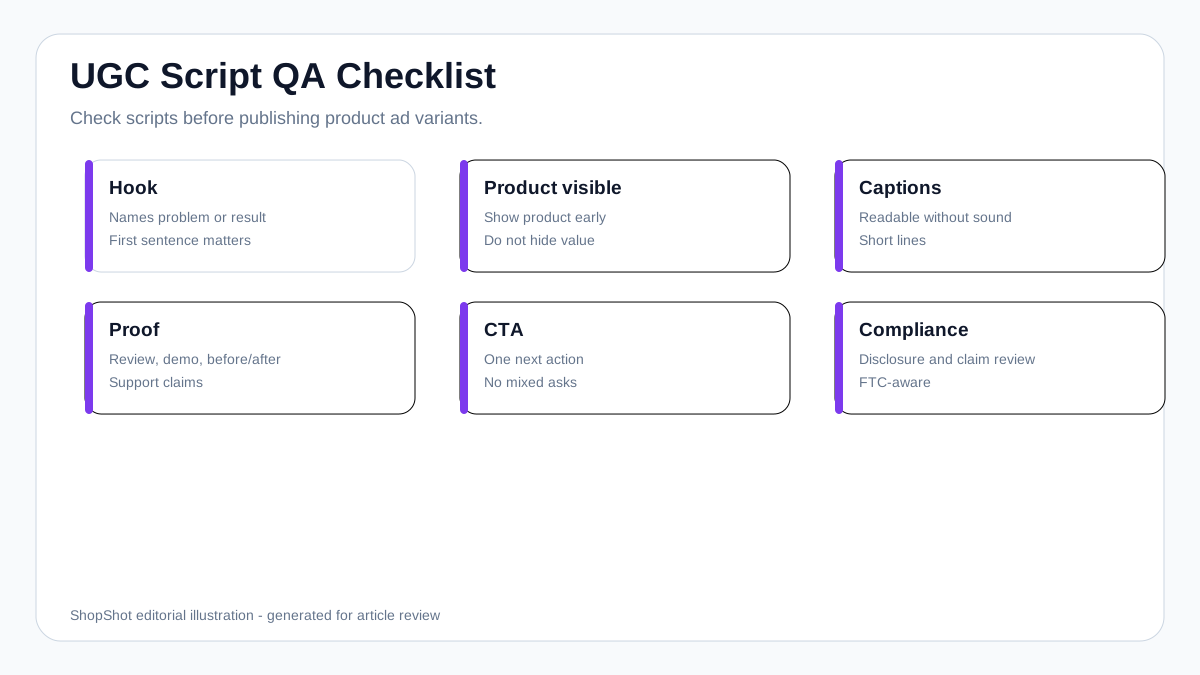
Before publishing, check:
- Does the first sentence name a problem, result, or curiosity?
- Is the product visible early?
- Can the viewer understand the ad without sound?
- Is there one clear CTA?
- Are claims specific and supportable?
- Does the script match the product page?
- Does the video avoid copying another brand's ad?
- Is the script short enough for the intended placement?
FAQ
What is a UGC script?
A UGC script is a short creator-style script that makes a product feel useful, believable, and relevant. It usually includes a hook, context, product moment, proof, and CTA.
How long should a UGC product ad script be?
Most short-form UGC product ads should be written for 15-30 seconds. Longer scripts can work for education-heavy products, but the first 3 seconds still need a clear hook.
Should UGC scripts sound scripted?
No. A good UGC script gives structure without sounding like a traditional commercial. Use short sentences, specific details, and natural spoken language.
Can I use AI to write UGC scripts?
Yes, but give the AI real product details, buyer objections, reviews, and use cases. Generic prompts produce generic ads. Use the templates in this article as structure.
How many UGC scripts should I test per product?
Start with at least 5 scripts: problem-solution, demo, review, comparison, and offer-led. Keep the product constant and vary the hook so you can learn what angle works.
What should be included in a UGC script brief?
A UGC script brief should include the product, buyer problem, target platform, opening hook, required product shots, proof source, CTA, claim limits, and disclosure requirements. The brief should tell the creator what must be shown, not only what should be said.
What is the difference between a UGC script and a shot list?
A UGC script controls the spoken message and CTA. A shot list controls the visual evidence: product use, problem scene, proof, before/after, close-up, and final product hero. Strong ecommerce ads need both.
Sources Checked
- TikTok Business Help Center: TikTok Auction In-Feed Ads
- Meta for Business: Instagram and Facebook Reels ads
- Reloop: UGC Script Templates: The Complete Guide to Creating High-Converting Content
- Revid: 15 UGC Script Templates to Boost Your Video Engagement
- Hookline: Best UGC Script Generator
- ShopShot internal plan: latest competitor keyword data from 2026-05-11