
Last reviewed: May 18, 2026.
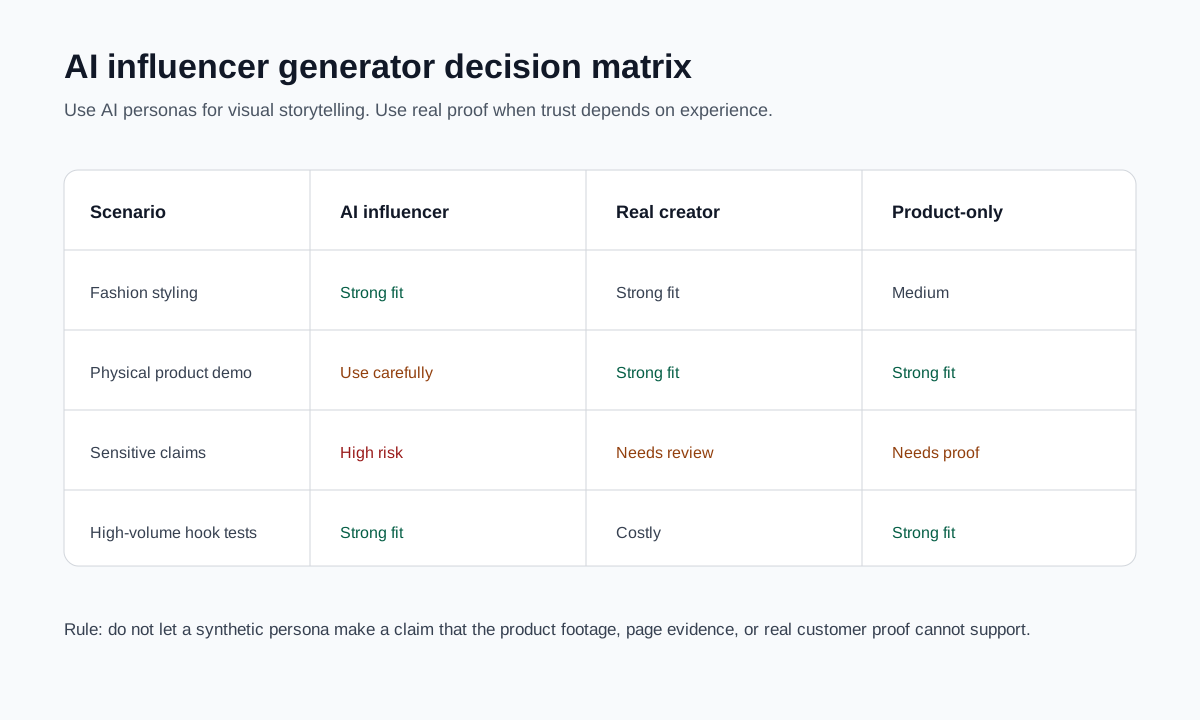
Quick Answer
An AI influencer generator can help ecommerce brands test persona-led product ads, especially for fashion, accessories, home goods, beauty concepts, and lifestyle products where visual style matters. It fails when the ad needs real product handling, authentic customer experience, expert credibility, or sensitive claims.
Use AI influencers as fictional presenters or visual concepts. Do not use them to fake a real customer, real creator, real celebrity, real expert, or personal product experience.
For ecommerce brands, the best use is controlled testing: compare AI influencer creative against real creator UGC and product-only videos using the same product proof, offer, and CTA. If the AI influencer wins only on cheap clicks but loses on comments, trust, or add-to-cart rate, it is not a real win.
What an AI Influencer Generator Is
An AI influencer generator creates a synthetic persona or avatar for social content and ads. The output can be a still image, a talking-head video, a product-holding scene, a fashion styling clip, a voiceover ad, or a short UGC-style video. Some workflows generate the influencer's look first, then build scripts and video scenes around a product.
For ecommerce, the appeal is obvious:
- You can test multiple personas without booking creators.
- You can create visual styles quickly.
- You can localize the same product ad across markets.
- You can produce more hooks and angles for lower upfront cost.
- You can make a product feel more lifestyle-driven than a plain product photo.
But the risk is also obvious. If the AI influencer appears to be a real person endorsing a product, buyers may assume there is real experience behind the recommendation. That is where compliance, trust, and platform review become important.
When AI Influencer Ads Work Best
| Ecommerce situation | Fit | Why it can work | Example |
|---|---|---|---|
| Fashion styling | Strong | Visual persona can show an aesthetic, outfit, or occasion | "Three ways to style this linen blazer" |
| Accessories | Strong | Product can be shown as part of a look | Sunglasses, jewelry, watches, bags |
| Home decor | Moderate | Persona can introduce a room style | "Warm minimal desk setup" |
| Beauty concept ads | Moderate | Visual style helps, but claims need care | Shade comparison or routine framing |
| Product launch teaser | Strong | Persona can create curiosity without claiming real use | "A new travel pouch for weekend packing" |
| Retargeting reminder | Moderate | AI persona can summarize features or offer | "Still comparing compact organizers?" |
| Supplements or wellness | Weak | Trust and claims are sensitive | Use product facts, expert review, and real proof |
| Baby, pet, or safety products | Weak | Buyers need real-world trust and safe-use context | Use real demonstrations and careful instructions |
The pattern: AI influencers are strongest for styling and attention, weaker for trust and proof.
The Compliance Boundary: Fictional Persona vs Fake Endorsement
The most important distinction is not technical. It is representational.
| Safer framing | Riskier framing |
|---|---|
| A fictional presenter introduces a product style. | A fake customer says they used the product. |
| A synthetic model shows a clothing combination. | A synthetic influencer claims personal results. |
| A brand-created persona explains features. | The ad implies an independent creator endorsement. |
| Product facts are taken from the product page. | Claims are invented for performance. |
| Real reviews are quoted accurately and separately. | Fake testimonials are generated from scratch. |
The FTC's endorsement guidance and consumer review rule are especially relevant here. The rule addresses fake or false reviews and testimonials, including situations involving people who do not exist or did not have actual product experience. TikTok also offers ad disclaimer options for AI-generated, synthetic, or manipulated media, and TikTok's AI-generated content guidance focuses on transparency for realistic AI media. Meta has also expanded transparency labeling for ads created or significantly edited using its own generative AI creative features.
For ecommerce teams, this means the creative review should ask: "What would a normal viewer believe about this person and this product?"
AI Influencer vs Real Creator vs Product-Only Creative
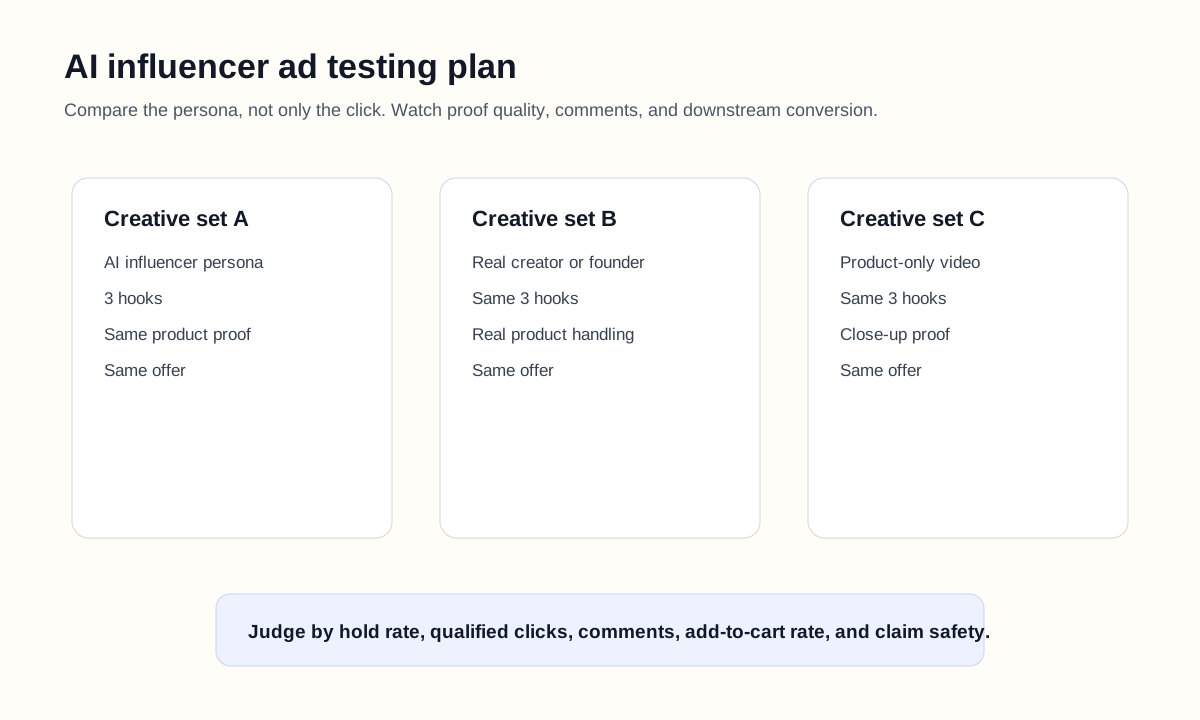
Do not evaluate AI influencer content in isolation. Test it against alternatives.
| Creative type | Strength | Weakness | Best use |
|---|---|---|---|
| AI influencer | Fast persona and style testing | Trust risk if it imitates real endorsement | Visual angles, fashion concepts, hook tests |
| Real creator | Authentic handling and lived experience | Slower, more expensive, less controllable | Trust-building, reviews, demonstrations |
| Product-only video | Product stays central | Can feel less human | PDP clips, retargeting, comparison, specs |
| Founder video | High trust if real | Founder availability and performance vary | Brand story, mission, premium launch |
| AI actor presenter | Clear explanation | Can feel generic if overused | Feature summary, multilingual retargeting |
For many brands, the best paid social mix is not one format. It is a portfolio:
- Product-only videos for clarity.
- Real creator videos for trust.
- AI influencer videos for style and iteration.
- AI voiceover or AI actor variants for localization and retargeting.
ShopShot's UGC videos for ecommerce workflow is useful here because it gives script and testing structure before you choose the visual format.
Category-Specific Recommendations
Fashion and apparel
AI influencer content can work well for styling ideas, seasonal looks, color combinations, and outfit concepts. It is weaker for fit proof. If the buyer needs to know how a dress moves, where pants sit on the waist, or how fabric behaves in natural light, use real model footage or real creator clips.
Safer AI influencer angle:
- "Three outfit ideas for a cropped denim jacket."
- "How to style this neutral tote for work and travel."
- "Color pairing ideas for spring linen shirts."
Riskier angle:
- "I wore this all day and it fits perfectly."
Beauty and skincare
AI influencer visuals can support shade discovery, packaging reveal, or routine education. They should not fake results. Before-after visuals, skin claims, medical language, and personal transformation claims need much stricter support.
Safer angle:
- "Compare the finish: matte packaging, refill format, and shade range."
Riskier angle:
- "This cleared my skin in a week."
Home goods
AI influencers can introduce room styles, desk setups, shelf organization, and decor themes. But scale and material accuracy matter. If a rug, lamp, or organizer is shown at the wrong size, the ad may create buyer disappointment.
Safer angle:
- "Three desk setup ideas using a compact lamp."
Riskier angle:
- A generated room scene that makes a small item look oversized or premium when it is not.
Electronics
AI influencer ads can explain features, but real interface proof is usually more convincing. Use screen capture, port close-ups, setup footage, or compatibility overlays.
Safer angle:
- "What to check before buying a portable projector: ports, brightness, distance, and size."
Riskier angle:
- Generated app screens or unrealistic product performance.
A Practical Persona Brief
Before using an AI influencer generator, define the persona like a creative test variable, not as a fake human identity.
| Brief field | Good ecommerce input |
|---|---|
| Persona role | Fictional stylist, product guide, gift finder, setup advisor |
| Product | Exact SKU, color, material, dimensions, offer |
| Buyer | Specific buyer segment and use case |
| Claim boundary | What the persona cannot say |
| Visual proof | Product close-up, lifestyle scene, review snippet, comparison |
| Tone | Practical, calm, energetic, premium, playful |
| Platform | TikTok, Reels, Shorts, PDP, retargeting |
| CTA | Shop the look, compare colors, check dimensions, see product details |
Bad brief:
Make a realistic influencer who loves this product and says it changed her life.
Better brief:
Create a fictional styling presenter for a 9:16 fashion product ad.
Product: black nylon crossbody bag.
Buyer: commuters who want a compact hands-free bag.
Proof: water-resistant nylon, front zipper pocket, adjustable strap, product close-up.
Claim limits: no personal use, no waterproof claim, no designer comparison.
Hook: "Need a small bag that still fits daily essentials?"
CTA: "Compare the colors on the product page."
Testing Plan for AI Influencer Product Ads
Run AI influencer creative as a controlled test. Do not change every variable at once.
| Variable | Keep constant | Test |
|---|---|---|
| Product | Same SKU and offer | AI influencer vs real creator vs product-only |
| Hook | Same three hook themes | Different persona delivery |
| Proof | Same product close-ups and facts | Different order of proof |
| CTA | Same CTA | Different voice or caption style |
| Format | Same 9:16 placement | Different opening visual |
Measure more than click-through rate.
| Metric | Why it matters |
|---|---|
| 2-second hold rate | Does the persona stop the scroll? |
| Average watch time | Does the video keep attention after novelty? |
| Qualified clicks | Are the clicks coming from likely buyers? |
| Add-to-cart rate | Does the creative create purchase intent? |
| Comment quality | Are viewers asking about the product or calling the ad fake? |
| Return/refund signals | Did the ad misrepresent the product? |
| Creative fatigue | Does performance drop quickly after novelty fades? |
If the AI influencer wins attention but loses product trust, use it as an upper-funnel concept, not as the main conversion ad.
Common Failure Modes
| Failure mode | Why it hurts performance |
|---|---|
| Persona over product | Viewers remember the face, not the item. |
| Fake testimonial language | Trust and compliance risk increase. |
| Unrealistic product rendering | Buyers may feel misled when they reach the product page. |
| Generic AI aesthetic | The ad blends into other AI-generated content. |
| No disclosure review | Platform or regulatory risk increases. |
| Same persona across all products | Brand starts to feel artificial. |
| No real product proof | Comments and conversion quality decline. |
How to Use AI Influencers Without Weakening Trust
-
Make the persona clearly brand-created or fictional.
Avoid pretending the person is an independent creator unless that is true. -
Put product proof in the video.
Show close-ups, use cases, product page facts, or real footage. The persona is not enough. -
Separate generated concepts from real reviews.
If you use real review language, quote it accurately and do not assign it to a synthetic person. -
Review claims before export.
Beauty, wellness, baby, pet, and finance-adjacent products need stricter review. -
Test against real creator and product-only ads.
AI influencer content should earn its place in the media mix. -
Refresh the persona strategy.
If every product uses the same synthetic face and cadence, creative fatigue can arrive quickly.
Example: Sunglasses Product Launch
Suppose a DTC brand is launching polarized sunglasses. A weak AI influencer ad says:
"I wore these on vacation and everyone asked where I got them."
That line implies real use and social proof. If the influencer is synthetic, it is the wrong frame.
A stronger AI influencer ad says:
"If you want one pair of sunglasses for beach days and city walks, compare three things: lens tint, frame weight, and face shape. This pair uses a lightweight square frame, polarized lenses, and three color options."
Then the video shows:
- Close-up of lens tint.
- Product on a neutral face shape or display stand.
- Side view of frame thickness.
- Case and packaging.
- Color options.
- CTA to compare the product page.
The AI influencer acts as a shopping guide. The product visuals do the selling.
Where This Fits in the ShopShot Content Cluster
This topic should stay a Blog article, not a tool landing page. The target searcher wants to understand if AI influencer generation is useful and safe for product ads. They are not necessarily ready for a generic "best AI influencer generator" list.
Useful next reads:
- For script structure, use UGC scripts for product ads.
- For broader examples and testing, use UGC videos for ecommerce.
- For fashion creative, use AI fashion video generator for clothing promo.
- For voice and localization choices, use AI voiceover options in UGC video tools.
FAQ
What is an AI influencer generator?
An AI influencer generator creates a synthetic persona, model, avatar, or presenter for social content and ads. For ecommerce, it can help test visual styles, hooks, product presentations, and short ad concepts.
Can AI influencers sell ecommerce products?
They can help with attention and styling, especially for fashion, accessories, beauty concepts, and lifestyle products. They are weaker when buyers need authentic use, physical demonstration, or trust from a real person.
Is AI influencer content risky?
It can be risky if it misleads viewers about identity, endorsement, product use, results, or whether the person is real. Use fictional framing, supportable claims, product proof, and platform-specific disclosure review.
How should ecommerce brands test AI influencers?
Test AI influencer ads against real creator videos and product-only videos using the same SKU, offer, proof points, and CTA. Evaluate hold rate, comment quality, add-to-cart rate, and downstream conversion, not only cheap clicks.
Should AI influencers replace real UGC creators?
No. AI influencers can expand testing volume and visual concepts, but real creators are stronger for physical use, genuine experience, trust-sensitive categories, and authentic testimonials.
Sources Checked
- FTC Endorsement Guides: What People Are Asking
- FTC Consumer Reviews and Testimonials Rule Q&A
- FTC final rule banning fake reviews and testimonials
- TikTok Newsroom: labels for AI-generated content
- TikTok Ads Manager: ad disclaimers
- Meta: Expanding GenAI transparency for ads products
- ShopShot internal planning files:
seo_article_plan_latest_competitor_keywords_2026-05-11.mdandpseo-interface-plan-ugc-video-tools.md