
Last reviewed: May 15, 2026. Platform specifications, ad policies, and disclosure rules can change; verify final requirements in each ad platform before launch.
Quick Answer
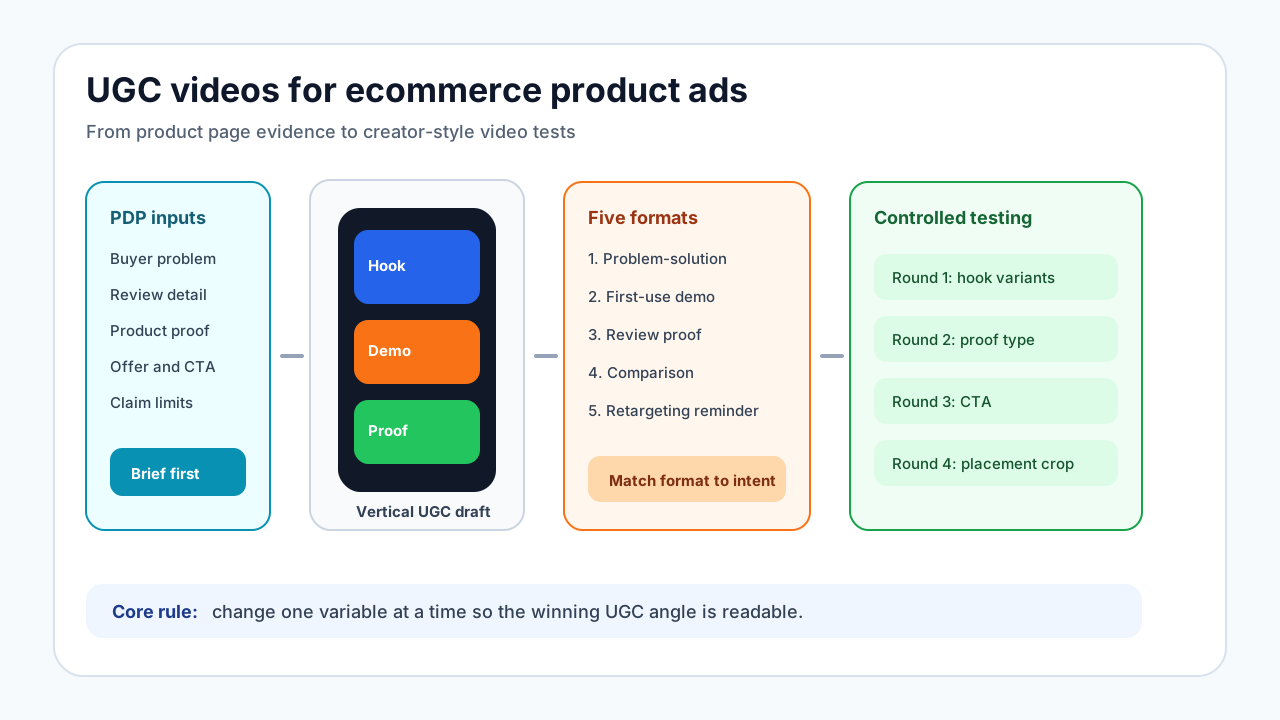
UGC videos for ecommerce product ads work best when they are planned as a repeatable testing system: one product, one buyer problem, one visible product moment, one proof point, and one CTA. Start with five formats: problem-solution, first-use demo, review-style proof, comparison, and retargeting reminder. For each format, write the hook, product moment, proof, CTA, shot list, and claim limits before filming or generating the video.
If you already have a script draft, compare it with the UGC script templates for product ads. If you are choosing tools or creators, use the UGC video production tools pricing guide to compare cost per usable ad, not only monthly price.
What Makes Ecommerce UGC Different
Generic UGC advice usually stops at "make it authentic." Ecommerce teams need a more specific standard because every video has to sell a real product with real constraints: product images, PDP claims, reviews, shipping offer, ad placement, usage rights, and compliance checks.
The strongest ecommerce UGC videos usually have four traits:
- The buyer problem appears before the product pitch.
- The product is shown early enough that the viewer understands what is being sold.
- The proof is concrete: a demo, review detail, comparison, result close-up, or objection answer.
- The CTA matches the funnel stage instead of forcing "buy now" into every video.
This is also where many ranking pages are thin. They list UGC video examples but do not show how a seller should turn a product page into scripts, scenes, tests, and review checks. This guide focuses on that workflow.
Ecommerce UGC Formats to Test First
| UGC format | Best use case | Required proof | Example hook | Risk to check |
|---|---|---|---|---|
| Problem-solution | Cold traffic and obvious pain points | Visible old way vs new way | "I stopped digging through my bag for this one thing." | Do not exaggerate the problem beyond what the product solves. |
| First-use demo | Products with satisfying setup, texture, fit, or reveal | Real hands-on product moment | "I wanted to see if this was actually easy to set up." | Avoid hiding setup steps that affect expectations. |
| Review-style proof | Trust-sensitive purchases and new brands | Review detail, usage context, or test period | "I bought this because my desk was always messy." | Disclose gifted or paid relationships clearly. |
| Comparison | Upgrades, alternatives, and commodity categories | Side-by-side difference | "I used to use a normal pouch. This is why I switched." | Avoid unsupported competitor claims. |
| Retargeting reminder | PDP visitors, cart abandoners, and warm audiences | Objection answer and offer recap | "Still deciding? Here is the part I did not notice at first." | Do not repeat a generic cold hook to a warm audience. |
| Founder or employee demo | New product, premium product, or complex mechanism | Clear explanation from someone close to the product | "We designed this for one specific problem." | Keep it useful; avoid turning it into a brand speech. |
| AI-assisted UGC concept | Fast creative testing before creator spend | Product page facts, static images, captions, voiceover | "If your [problem] looks like this, try this setup." | Do not imply a real person used the product if that is not true. |
Example 1: Problem-Solution UGC for a Desk Organizer
Product: compact desk organizer for keys, wallet, watch, and charger.
Buyer problem: the buyer loses small daily items around the desk or entry table.
Proof: side-by-side shot of the old messy desk and the organized tray.
Script:
0-2s hook:
If your desk turns into a drop zone every night, this is the setup I use now.

2-6s context:
I used to leave my keys, charger, wallet, and watch in four different places.

6-12s product moment:
This tray gives each item a visible spot, so I can drop everything in one motion.

12-18s proof:
The biggest difference is that my charger and keys are not buried under papers anymore.

18-22s CTA:
Check the organizer details if you want a cleaner desk routine.
Shot list:
| Scene | Visual | Notes |
|---|---|---|
| Problem | Messy desk close-up | Shoot from buyer point of view. |
| Old way | Hand searching for keys | Keep this short; do not overact. |
| Product reveal | Organizer placed on desk | Show the full product before details. |
| Mechanism | Keys, wallet, watch, charger placed into sections | Use one continuous motion if possible. |
| Proof | Before/after split or final clean desk | Add captions for viewers without sound. |
| CTA | Product hero with simple text | Use one action only. |
Example 2: First-Use Demo UGC for a Travel Jewelry Case
This format works when the product benefit is visible through organization, texture, setup, or compactness.
Script:
Hook:
I packed necklaces without them turning into one giant knot.

Product moment:
The case has separate tabs for necklaces, earrings, and rings, so each piece has its own spot.

Proof:
Here is what it looked like after I closed it, shook it in my bag, and opened it again.

CTA:
Use it for your next trip if tangled jewelry is the part you always dread.
Why this can beat a generic review video:
- It shows one outcome the buyer can inspect.
- It uses a simple test instead of a vague claim.
- It creates natural cut points for Reels, TikTok, Shorts, and PDP video.
Do not claim the case "prevents all tangling" unless the product has evidence for that wording. A safer claim is "helps keep pieces separated."
Example 3: Retargeting UGC for an Insulated Lunch Bag
Retargeting UGC should answer the question that likely stopped the buyer. For a lunch bag, the objection might be size, cleaning, durability, or whether it fits a specific container.
Script:
Hook:
If you liked the lunch bag but were not sure about the size, here is what fits inside.

Product moment:
One meal prep box, one snack container, a small bottle, and an ice pack.

Proof:
The wide opening is the useful part because you can see everything instead of stacking containers blindly.

CTA:
Check the size chart on the product page before choosing your color.
This is a better warm-audience ad than a broad lifestyle montage because it reduces purchase friction. It also gives AI search engines a clear answer: retargeting UGC should resolve a buyer objection, not repeat the same cold-traffic hook.
The Product Page to UGC Brief
Before you film, hire a creator, or generate an AI-assisted draft, convert the product page into a UGC brief.
| PDP input | What to extract | How it appears in the video |
|---|---|---|
| Product name | Plain-language product category | "This compact desk organizer..." |
| Primary buyer | Who the video is for | "If your work desk gets messy..." |
| Main feature | One visual mechanism | Separate trays, foldable design, magnetic closure |
| Review detail | Real buyer language | "I can finally find my keys before leaving." |
| Objection | Reason someone hesitates | Size, durability, cleaning, fit, setup, price |
| Product proof | What can be shown safely | Demo, measurement, side-by-side, close-up, review text |
| Offer | Final action only | Bundle, discount, free shipping, product page CTA |
| Claim limits | Words to avoid | Medical, guaranteed, competitor, or unsupported performance claims |
The mistake is trying to write UGC from a blank page. A stronger workflow starts from the product page and customer objections, then turns them into scenes.
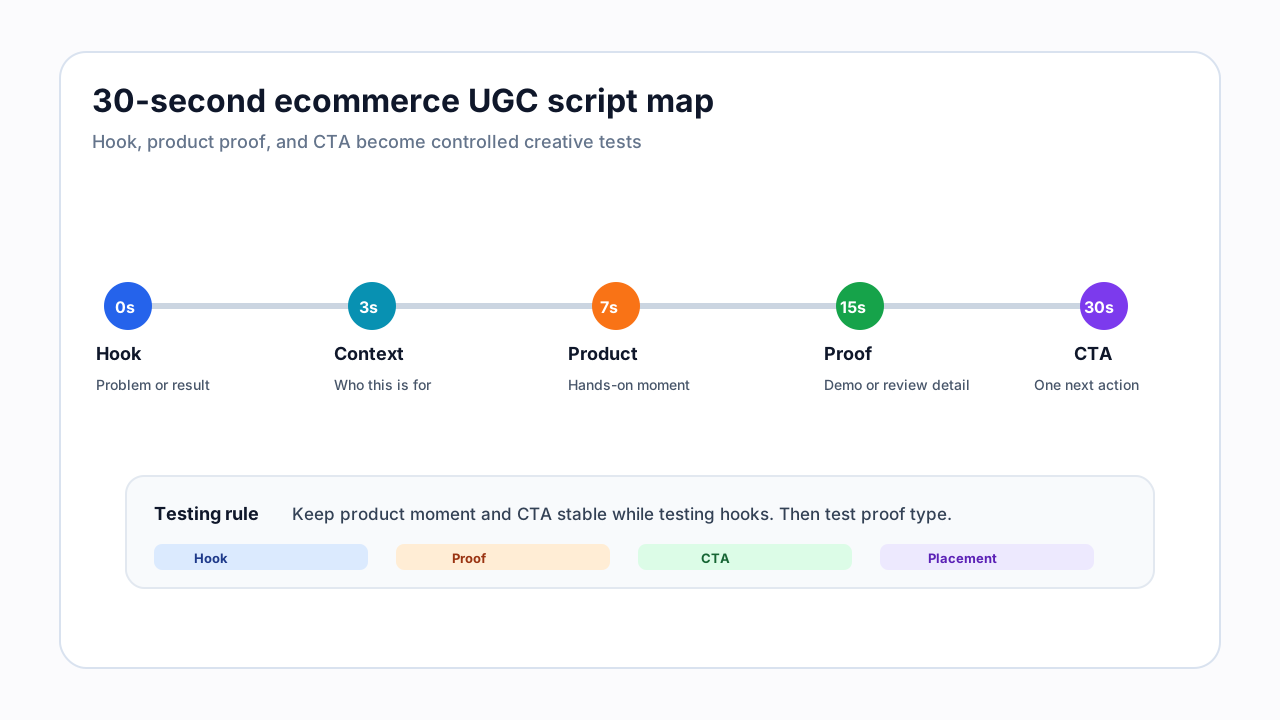
30-Second Ecommerce UGC Script Formula
| Time | Job | Script prompt | Visual prompt |
|---|---|---|---|
| 0-3s | Stop the scroll | "If you deal with [specific problem]..." | Problem close-up, result shot, or unusual product use |
| 3-7s | Qualify the buyer | "I needed this because [buyer context]." | Buyer using the old workaround |
| 7-15s | Show the product | "This works by [simple mechanism]." | Hands using the product in a real setting |
| 15-23s | Add proof | "The part I noticed most was [specific proof]." | Detail close-up, comparison, review snippet, or result |
| 23-30s | Move to action | "Check [product/size/color/details] before buying." | Product hero, offer, or PDP screen |
For a 15-second version, remove the context line and keep the hook, mechanism, proof, and CTA.
AI-Assisted Workflow Without Faking Experience
AI can help produce ecommerce UGC faster, but it should not pretend that a real customer used a product when they did not. Use AI for:
- Turning PDP copy into hook variations.
- Converting reviews into safer proof lines.
- Creating scene plans from product photos.
- Generating captions and voiceover drafts.
- Making first-pass product ad variants for creative testing.
Use a real creator, founder, employee, or original footage when the product requires physical use, body fit, texture, real durability testing, or high-trust personal experience. If a video includes a paid creator, gifted product, affiliate relationship, or other material connection, the FTC expects clear disclosure.
Testing Workflow for Small Ecommerce Brands
Start with a controlled test. Do not change the hook, product, proof, CTA, and placement all at once.
| Test round | Keep stable | Change | What you learn |
|---|---|---|---|
| Round 1 | Product, product shot, CTA | Hook | Which buyer problem earns attention |
| Round 2 | Winning hook, product, CTA | Proof type | Whether demo, review, or comparison drives intent |
| Round 3 | Winning hook and proof | CTA wording | Whether the viewer needs "see details," "shop now," or "compare sizes" |
| Round 4 | Core script | Placement crop and pacing | Which version works for TikTok, Reels, Shorts, Feed, or PDP |
| Round 5 | Winning concept | Creator angle or voiceover | Whether delivery style changes performance |
For low-budget tests, create 3-5 hook variants around the same product moment. Once a hook works, improve proof and placement fit before changing the whole concept.
Placement Notes
TikTok, Reels, Shorts, Feed, and Stories do not behave like one universal video slot. TikTok's ad specs and most short-form placements favor vertical, mobile-first creative; Meta Reels placements also reward full-screen vertical assets; YouTube Shorts is built around vertical short-form viewing. Treat these platform details as production constraints, not afterthoughts.
Practical rules:
- Build the first version in 9:16 if the main distribution is TikTok, Reels, Shorts, or Stories.
- Put the product in frame early; do not spend the first seconds on a logo.
- Add burned-in captions because many viewers watch without sound.
- Keep safe margins for UI overlays, captions, and product labels.
- Make separate cuts for cold traffic, retargeting, and product page use.
Internal Links for the ShopShot Cluster
Use these links where they naturally help the reader:
- UGC script templates for product ads
- Compare pricing for UGC video production tools
- Compare AI voiceover options in UGC video tools
- TikTok Creative Center workflow for ecommerce product ads
- Instagram ad template guide for ecommerce product videos
UGC Production QA Checklist
Run this check before publishing or sending a video to ads manager:
- The first 3 seconds show a buyer problem, result, or product moment.
- The product appears clearly before the midpoint.
- Captions are readable on mobile.
- The CTA matches funnel stage and placement.
- Any review, testimonial, or paid relationship is disclosed where required.
- The video does not make unsupported performance, medical, income, or competitor claims.
- The crop works in the target placement.
- Product labels, size, colors, and offer details match the live product page.
FAQ
What are UGC videos for ecommerce?
UGC videos for ecommerce are creator-style product videos that show a product in a buyer context, usually with a hook, product moment, proof, and CTA. They can be filmed by creators, made in-house, or generated with AI support, as long as claims, usage rights, and disclosures are handled honestly.
What is the best UGC video format for ecommerce product ads?
The best starting format is usually problem-solution because it makes the product relevant quickly. If the product benefit is visual, a first-use demo or comparison can work better. For warm audiences, use retargeting UGC that answers a specific objection.
How long should ecommerce UGC videos be?
Start with 15-30 seconds for paid social. Use the first 3 seconds for the hook, the middle for the product mechanism, and the final frame for proof or CTA. Longer versions can work on product pages when the product needs explanation.
Can AI-generated UGC videos replace real creators?
AI-generated UGC videos are useful for fast testing, product concepts, captions, voiceover, and placement variants. Real creators still matter when the product requires physical use, lived experience, body fit, texture, or high-trust testimonial context.
How many UGC video variants should I test first?
Start with 3-5 hook variants for one product and one product moment. Once a hook works, test proof type, CTA, creator delivery, and placement versions instead of changing everything at once.
Sources Checked
- TikTok video ad specifications: TikTok Ads Help Center
- Meta Reels ad format guidance: Meta for Business Reels Ads
- YouTube and Google video ad guidance: Google Ads Help
- FTC disclosure and endorsement guidance: FTC Endorsement Guides FAQ
- UGC script structure reference: Reloop UGC script templates