
Quick Answer
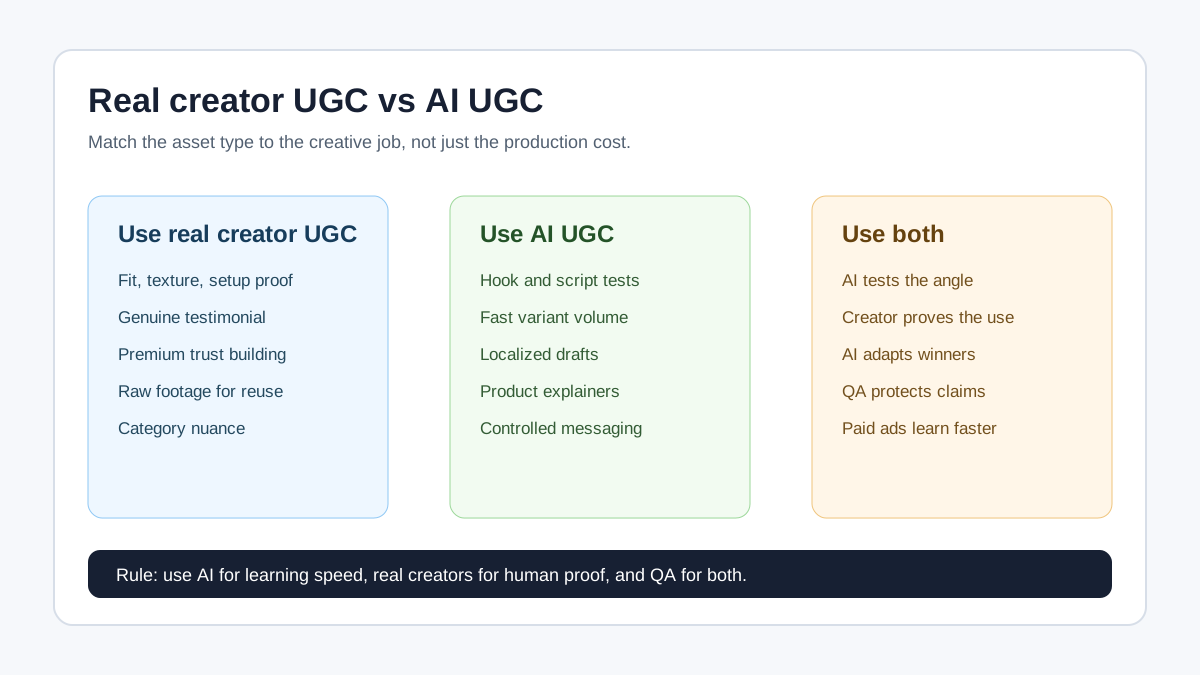
Real creator UGC is strongest when an ecommerce ad needs lived-in product use, visible trust, a believable testimonial, or category-specific nuance. AI UGC is strongest when the team needs fast creative variants, localized scripts, low-risk product demos, or a way to test hooks before paying creators. The safest 2026 workflow is usually hybrid: use AI UGC to test angles and produce volume, then use real creators for proof, reviews, and winner validation.
For paid ads, do not choose based only on cost per asset. Choose based on the job of the video:
- Use real creators for trust, personal experience, sensory detail, and testimonial-style claims.
- Use AI UGC for speed, controlled messaging, localization, script tests, and product education.
- Use both when you need many hooks but still need a real person to prove the product works in context.
If you already have a product truth file, turn it into a controlled creator or AI brief with the UGC video brief template. If you still need the opening angles, start with the UGC video hooks guide.
Why This Decision Matters Now
AI UGC has moved from novelty to production workflow. Ecommerce teams can generate presenter-style clips, translated voiceovers, product demos, and dozens of hook variants faster than a traditional creator shoot. That speed is useful, but it also creates a new quality problem: a brand can produce more ads than it can verify.
Real creator UGC has the opposite constraint. It is slower, more expensive, and harder to revise, but it can show first-hand use, messy context, real handling, personal language, and genuine uncertainty. Those signals matter when the product is worn, tasted, fitted, assembled, cleaned, compared, or used around a real household.
The SEO and ad-performance question is not "Which one is better?" The useful question is "Which asset type should own which part of the creative system?"
Google's ABCDs guidance emphasizes attention, branding, connection, and direction. TikTok's Creative Codes recommend TikTok-first content, structure, stimulation, and sound. FTC guidance for endorsements and material connections still applies when the ad uses people, creators, testimonials, or paid relationships. Those principles point to the same operational answer: use AI for controlled production, but do not let AI invent human proof.
Real Creator UGC vs AI UGC: The Decision Matrix
Use this table before assigning a creative brief.
| Ad job | Real creator UGC | AI UGC | Recommended choice |
|---|---|---|---|
| Show product fit on a real body | Strong because body type, movement, and scale are visible | Risky if fit or texture must be exact | Real creator |
| Test 20 hook angles in one week | Slow and expensive | Strong for script, voice, and scene variation | AI UGC first |
| Explain a simple product feature | Good if creator adds natural context | Strong if visuals can be verified against product truth | AI or hybrid |
| Deliver a testimonial-style review | Strong only when the experience is genuine and disclosed | High risk if it implies personal use that did not happen | Real creator |
| Localize one winning ad | Expensive across languages and regions | Strong for translated voice, captions, and adapted scripts | AI UGC with QA |
| Build brand trust for a premium product | Strong because the person can show care and ownership | Useful as support, but less credible as the main proof | Real creator |
| Create first draft scripts and storyboards | Useful but costly | Strong for speed and iteration | AI UGC |
| Demonstrate a regulated or claim-sensitive product | Good if claims are tightly briefed | Risky if prompts overstate results | Real creator with strict review |
The pattern is simple. Use real creators when the value comes from the person. Use AI UGC when the value comes from structure, message control, speed, and variant volume.
When Real Creator UGC Wins
Real creator UGC is not automatically better because it is human. It wins when the ad needs evidence that is hard to simulate.
1. The product needs touch, fit, or setup proof
Apparel, skincare, home goods, pet products, kitchen tools, and accessories often need real interaction. The shopper wants to see how the product behaves outside a polished product page. A creator can show fabric movement, texture, size, setup difficulty, packaging, cleanup, or daily routine context.
For example, a dress ad may need walking, sitting, turning, and close fabric shots. A storage product may need cabinet measurements and a messy before shot. A supplement or skincare product may require extra care because testimonial claims can easily become unsupported health or performance claims.
2. The ad depends on trust
If the script sounds like "I tried this and here is what happened," real creator UGC is usually the safer format. A synthetic presenter can explain a product, but it should not pretend to be an ordinary customer with first-hand experience.
The FTC's endorsement guidance focuses on whether consumers understand the connection between the advertiser and the person making the endorsement. For ecommerce teams, the practical rule is to brief disclosure and claim boundaries before filming, not after a winning ad is found.
3. The product has emotional or lifestyle nuance
Some products sell through identity, routine, or personal detail. A creator can bring pauses, imperfections, household context, facial reactions, and category language that makes the video feel native to the platform. AI can mimic some of this, but the risk is sameness: many AI UGC clips can start to feel polished in the same way.
4. You need reusable raw footage
Raw creator footage is a long-term asset. A good shoot can become TikTok ads, Reels, Shorts, Meta variants, product detail page media, email clips, and retargeting cuts. If the creator captures clean product handling and multiple proof moments, your team can build many edits without asking the creator to refilm everything.
When AI UGC Wins
AI UGC is strongest when the content job is controlled, repeatable, and easy to verify.
1. You need creative volume
Paid social testing requires more than one video. Teams need different hooks, offers, captions, scene orders, and CTAs. AI UGC can quickly turn one product truth file into many testable variations. That lets you find weak angles before spending creator budget.
Use AI for:
- Hook exploration.
- First-pass product explainers.
- Voiceover and caption variants.
- Localization drafts.
- Founder or presenter-style educational clips.
- Product-page-to-video drafts from images and copy.
If you need this workflow, start from the product video script template, then adapt the winning script into scenes with ShopShot's AI video generator.
2. The product proof is visual and objective
AI UGC can work well when the ad shows simple, page-backed information: product features, use steps, size callouts, bundle contents, offer reminders, or before-and-after organization scenes that are not making exaggerated claims.
The key phrase is page-backed. If the product page, reviews, or documentation do not support the claim, the AI output should not say it.
3. You need fast localization
Creator localization can be expensive because every market may need new talent, language review, and cultural nuance. AI can help adapt captions, voice, and scripts quickly. Still, do not publish localized AI UGC without native review. Literal translation can miss claims, tone, and compliance issues.
4. You need to learn before you produce
AI UGC is useful as a pre-production filter. Before booking creators, test whether shoppers respond to "problem first," "demo first," "objection first," or "comparison first." Once a hook family wins, give that evidence to real creators so the shoot starts from a stronger brief.
The Hybrid Workflow That Usually Works Best
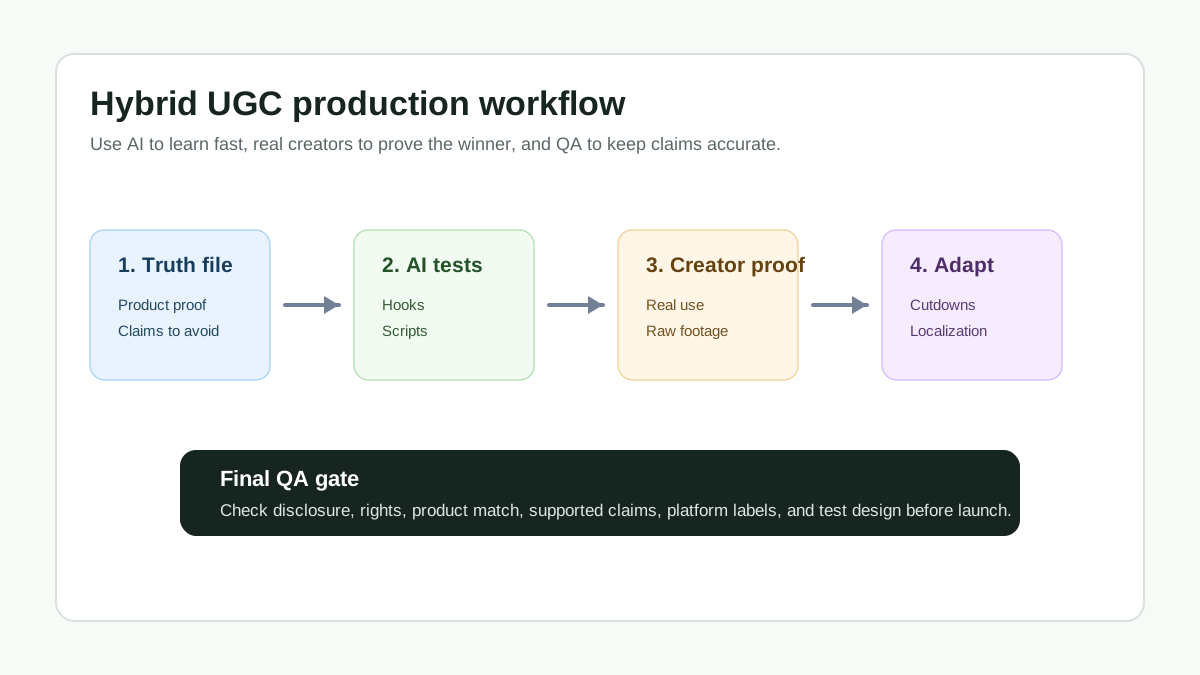
The strongest ecommerce teams do not treat real creator UGC and AI UGC as enemies. They assign different jobs to each asset type.
Step 1: Build the product truth file
Collect the facts that every version must respect:
- Product name, variant, price range, and offer.
- Product page claims and proof.
- Reviews that can be paraphrased accurately.
- Visual features that must appear.
- Claims to avoid.
- Disclosure and usage requirements.
- Platform ratio, length, and safe-zone needs.
This prevents both a creator and an AI workflow from improvising unsupported promises.
Step 2: Use AI UGC to test the message
Create several controlled variations from the same truth file. Change one variable at a time.
| Variant | What changes | What stays stable |
|---|---|---|
| A: Problem-first | Opens with the shopper pain | Product proof, offer, CTA |
| B: Demo-first | Opens with the product in action | Product proof, offer, CTA |
| C: Objection-first | Opens by answering a buying concern | Product proof, offer, CTA |
| D: Comparison-first | Opens with the old workaround | Product proof, offer, CTA |
This gives you a cleaner read than changing the hook, product claim, price, creator style, and CTA all at once.
Step 3: Send winners to real creators
Once a hook or proof angle works, brief real creators with the result. Do not ask them to copy the AI line word for word. Ask them to show the same product proof in their own language and environment.
This is where real creator UGC becomes valuable. The AI test tells you what the market may care about. The creator shoot gives you human proof, original raw footage, and better long-term trust signals.
Step 4: Use AI again for cutdowns and localization
After the real creator asset wins, use AI-assisted production to adapt the asset responsibly:
- Generate subtitle versions.
- Create short cutdowns from the same proof.
- Translate or dub only after review.
- Build product-page or email variants.
- Test alternate CTAs while keeping the proof stable.
Connect this stage to the how many UGC video ads to test framework so the team knows what each variant is supposed to teach.
Disclosure and Claim QA
Real creator UGC and AI UGC both need review, but the risk profile is different.
| Risk | Real creator UGC control | AI UGC control |
|---|---|---|
| Material connection | Require clear disclosure for paid, gifted, affiliate, or sponsored content | Do not imply an independent customer relationship if the person is synthetic |
| Personal experience | Let creators describe what they actually experienced | Avoid "I used this for 30 days" unless it is a real, substantiated case |
| Product claims | Give creators a do-and-avoid list | Lock prompts to approved claims from the product page |
| Visual accuracy | Check variant, size, texture, color, and setup | Check generated visuals against actual product assets |
| Platform labeling | Use each platform's branded content or ad disclosure features where applicable | Check AI labeling rules and advertiser disclosure requirements |
| Rights | Confirm paid usage, edit rights, music, voice, and duration | Confirm rights for AI-generated people, voice, music, and inputs |
Meta says AI info may appear on ads created or materially edited with Meta's generative AI creative features, and it distinguishes those labels from organic content labels. TikTok's Creative Codes emphasize native structure, sound, and clear hooks. Google's ABCDs emphasize attention, branding, connection, and direction. None of those remove the brand's responsibility to keep the product claim accurate.
Cost and Speed Are Not the Whole Decision
AI UGC often appears cheaper because the first asset can be created quickly. Real creator UGC often appears more expensive because it includes talent, shipping, usage rights, revisions, and scheduling. But the real metric is cost per usable learning.
| Metric | What to measure |
|---|---|
| Cost per approved asset | Total production cost divided by assets that pass QA |
| Cost per tested angle | Total cost divided by distinct hooks or proof angles tested |
| Cost per winner | Total cost divided by creatives that reach your performance threshold |
| Time to first test | Days from brief to launch-ready ad |
| Trust value | Whether the asset can support testimonial, PDP, email, and retargeting use |
| Reuse value | Whether the footage can become new cuts without new production |
This is why a hybrid workflow often beats a single-format workflow. AI UGC lowers the cost of learning. Real creator UGC raises the trust value of the winners.
A Practical Brief Split
Use this split when assigning work.
| Brief item | Give to AI UGC | Give to real creators |
|---|---|---|
| Product truth file | Yes | Yes |
| Hook angles | Yes, many versions | Yes, fewer stronger options |
| Exact scripted lines | Good for first drafts | Use sparingly |
| Required proof scenes | Yes | Yes |
| Personal experience | No, unless based on real source material | Yes, if genuine |
| Raw footage request | Not relevant unless using source video | Yes |
| Usage rights | Check tool and asset terms | Contract clearly |
| Disclosure | Avoid fake customer framing | Require sponsored, gifted, or affiliate disclosure when needed |
The same product truth file can power both workflows. The difference is how much human experience the ad claims to show.
Common Mistakes
Treating AI UGC like fake real UGC
AI UGC should not pretend to be an undisclosed ordinary customer. Use it as a presenter, explainer, demo, or variant-production system. If the ad implies lived experience, make sure there is real evidence behind it.
Sending creators vague prompts
"Make it authentic" is not a brief. Give creators the buyer problem, product proof, usage rights, platform, claim boundaries, and testing goal. The creator can still choose natural language.
Scaling AI variants without review
More variants also mean more chances for wrong details. Check product color, size, use limits, claims, pricing, offer, and page match before launching.
Comparing one AI ad against one creator ad
That is not a fair test. Compare systems. AI UGC may produce 20 hooks quickly. Real creator UGC may produce fewer assets but more durable proof. Judge each by its assigned role.
FAQ
Is AI UGC better than real creator UGC for ecommerce ads?
Not always. AI UGC is better for speed, testing, localization, and controlled explanations. Real creator UGC is better for trust, real product handling, testimonials, and category nuance.
Can AI UGC replace creators?
AI UGC can replace some early drafts, script tests, and simple presenter clips. It should not replace real creators when the ad depends on personal experience, fit, texture, sensory detail, or a testimonial-style claim.
Should ecommerce brands disclose AI UGC?
Check platform rules and local law before launch. At minimum, avoid framing synthetic people as independent customers. For paid or gifted creator content, follow endorsement disclosure requirements.
What is the best workflow for real creator UGC vs AI UGC?
Use AI UGC to test hooks and product messages, then brief real creators to produce the winning proof angles. After that, use AI-assisted editing for cutdowns, captions, and localization.
How many AI UGC variants should I test before hiring creators?
Start with 6 to 12 controlled variants across two or three hook families. If one family wins, use that result to brief creators instead of asking them to guess from scratch.
Sources Checked
- FTC: Endorsements, Influencers, and Reviews, checked June 24, 2026, for endorsement and material-connection guidance.
- FTC Endorsement Guides: What People Are Asking, checked June 24, 2026, for social influencer disclosure examples.
- TikTok Creative Codes, checked June 24, 2026, for TikTok-first structure, hook, body, close, and sound guidance.
- TikTok One Creative Suite, checked June 24, 2026, for creator collaboration, Top Ads research, and AI creative workflow references.
- Google Ads Help: About the ABCDs of effective video ads, checked June 24, 2026, for Attention, Branding, Connection, and Direction principles.
- Meta Help Center: How AI-generated images in ads are identified and labeled on Meta, checked June 24, 2026, for current AI info labeling notes on ads.