
Quick Answer
Most ecommerce brands should test 6 to 12 UGC video ads per month when they are spending under $10,000 per month on paid social, 12 to 24 videos per month when they are spending $10,000 to $50,000, and 30 or more videos per month when creative fatigue is already limiting scale. The right number is not a vanity production target. It is the number of meaningfully different angles your budget can give enough delivery to judge.
A small store does not need 50 videos if each one receives $8 of spend and no conversions. A scaling brand should not rely on 3 polished videos for a whole month if CPA rises after the first week. The practical answer is to test in batches: 4 to 6 videos at a time for smaller budgets, 8 to 12 for mid-market accounts, and a weekly pipeline for larger accounts. Each batch should change the hook, problem angle, proof, creator style, or format, not just swap captions on the same footage.
Why the Number Changed
UGC video ads used to be treated like campaign assets. A brand made a few creator videos, launched them on Meta or TikTok, and waited for the platform to find a winner. That was workable when targeting levers were more visible and the feed had less creative competition.
In 2026, the bottleneck is different. Meta, TikTok, and Google all lean heavily on automated delivery and creative selection. Their systems can match ads to viewers, crop or adapt assets, and optimize toward campaign goals, but they still need enough distinct creative inputs. TikTok's own creative guidance emphasizes continuous testing and fatigue prevention. TikTok Smart Creative also describes an automated process that tests differentiated creative combinations over an initial 3 to 5 day observation window. Meta's Advantage+ Creative messaging similarly frames diversified creative as a way to tailor variations to different viewers.
That does not mean "more ads" is always better. If 20 videos express the same promise, use the same opening shot, show the same creator, and make the same claim, you may have 20 files but only one idea. The better question is:
How many distinct creative bets can we afford to test this month without starving each one of delivery?
This article gives ecommerce teams a working answer.
A Practical Testing Rule
Use this rule before you approve a UGC batch:
Test enough videos to cover 3 to 5 meaningfully different angles, but not so many that each video cannot reach a useful spend or signal threshold.
For most ecommerce teams, a useful first-read threshold is one of these:
| Test signal | When to use it | Minimum read before judging |
|---|---|---|
| Hook signal | TikTok, Reels, Shorts, cold traffic | 1,000 to 3,000 impressions per video |
| Click signal | Low-ticket ecommerce with fast traffic | 50 to 100 landing page clicks |
| Add-to-cart signal | Shopify stores with enough volume | 5 to 10 add-to-carts |
| CPA signal | Mature paid social accounts | 1 to 3 target-CPA spend per video |
| Retention signal | Video-first campaigns | 25%, 50%, and 95% view benchmarks |
If you cannot reach any of those thresholds, reduce the number of videos in the first batch. If every video clears the threshold quickly, increase the next batch.
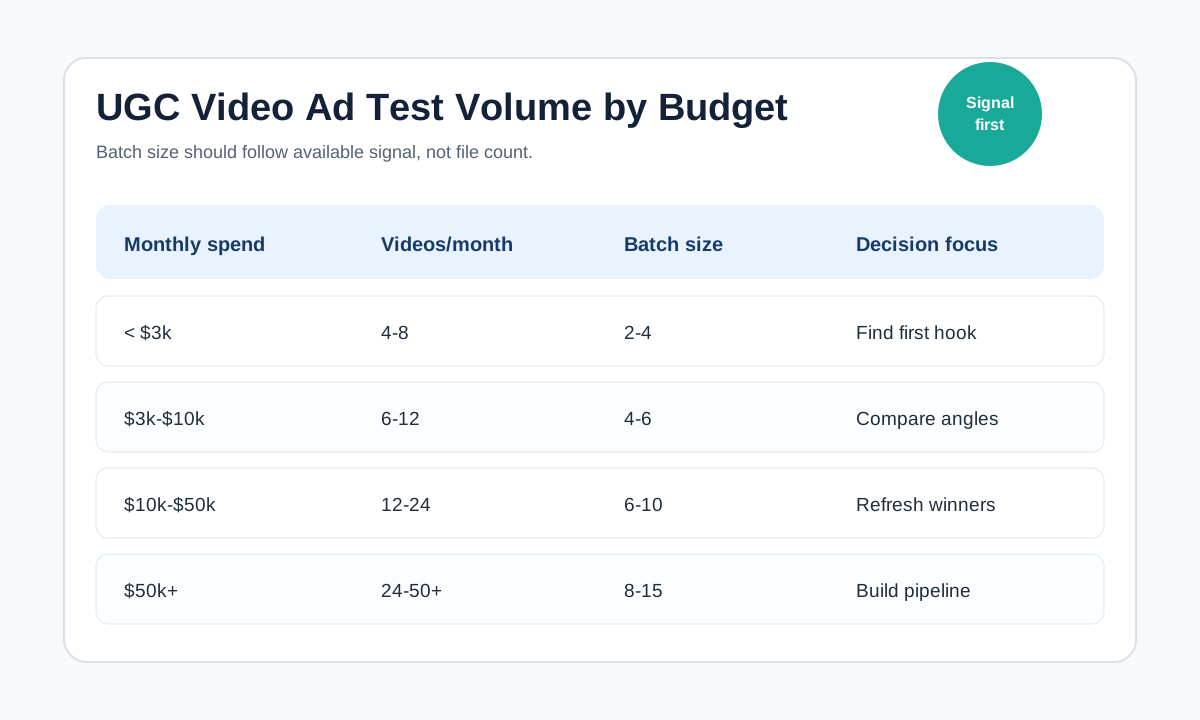
Recommended UGC Video Ad Volume by Monthly Spend
The table below is a starting point for ecommerce brands running Meta, TikTok, Instagram Reels, YouTube Shorts, or mixed paid social campaigns.
| Monthly paid social spend | Monthly UGC video ads to test | Batch size | Review cadence | Best use case |
|---|---|---|---|---|
| Under $3,000 | 4 to 8 | 2 to 4 | Every 7 to 10 days | Find one promising hook and one offer angle |
| $3,000 to $10,000 | 6 to 12 | 4 to 6 | Weekly | Test hooks, creator types, and proof formats |
| $10,000 to $50,000 | 12 to 24 | 6 to 10 | Twice weekly | Keep winners fresh and find new angles |
| $50,000 to $150,000 | 24 to 50 | 8 to 15 | Twice weekly or daily | Maintain a creative pipeline across platforms |
| Over $150,000 | 50+ | Weekly pods | Daily | Treat creative as an operating system, not a campaign task |
The spend tiers matter because each video needs a fair chance to receive delivery. A $2,000 monthly budget spread across 20 ads creates a reporting illusion: Ads Manager displays many rows, but most rows never had enough exposure to prove anything. A $100,000 monthly budget with only 6 videos has the opposite problem: the account may overexpose the same ideas, hit fatigue, and force the algorithm to keep spending on old creative.
The 6-12-24 Framework
If you need a simple answer, use the 6-12-24 framework.
Test 6 videos when budget is tight
Use 6 videos when you are validating a new offer, launching a small product line, or spending less than about $300 per day across paid social. Keep the structure simple:
| Video | Variable to test | Example |
|---|---|---|
| 1 | Problem hook | "Still using product photos that do not explain the product?" |
| 2 | Outcome hook | "Here is the 15-second ad angle that made this product clearer." |
| 3 | Creator style | Founder-led demo |
| 4 | Creator style | Customer-style review |
| 5 | Proof format | Before and after |
| 6 | Offer format | Bundle, discount, or free shipping CTA |
Do not try to test voiceover, caption style, CTA, background, creator, hook, and offer all at once. Six videos should answer one main question: which angle deserves more production?
Test 12 videos when you need a real monthly pipeline
Twelve videos per month is the practical default for many ecommerce teams. It gives you enough coverage to test multiple hooks without creating reporting noise.
A 12-video month can look like this:
| Creative pod | Videos | Purpose |
|---|---|---|
| Hook pod | 4 | Same product and offer, different first 3 seconds |
| Proof pod | 3 | Review, comparison, result, or demo evidence |
| Persona pod | 3 | Different creator types or customer situations |
| Format pod | 2 | Reels-style UGC, direct demo, product close-up |
This is also a good volume for teams using AI-assisted production. You can keep the human strategy layer in place while using AI to turn product images, scripts, and hooks into more testable variants.
Test 24 or more videos when fatigue is your growth ceiling
Move above 24 videos per month when the account has enough spend and the main issue is creative fatigue. Signs include:
- CPA rises while landing page conversion rate stays stable.
- Frequency climbs on winning ad sets.
- The same winner consumes most spend for too long.
- New ads receive delivery, but only minor edits fail to change performance.
- The account has good products and offers, but not enough new creative ideas.
At this level, you need a creative calendar, not occasional creator orders. Each week should produce a set of new angles, not only a new edit of last week's winner.
What Counts as a New UGC Video Ad?
Counting files is easy. Counting ideas is harder.
A new UGC video ad should change at least one of these high-signal variables:
| Variable | Weak variation | Strong variation |
|---|---|---|
| Hook | Same line with different subtitle color | New opening problem or promise |
| Creator | Same footage with a crop change | Different creator type or customer situation |
| Product proof | Same demo sequence | New evidence: review, comparison, result, use case |
| Offer | Same CTA phrasing | Different offer framing or urgency |
| Format | 1:1 crop of the same video | Native Reels/TikTok framing with different pacing |
| Audience angle | Broad "everyone" message | Use-case angle for a specific buyer segment |
If your testing backlog says "make 10 more UGC videos," rewrite it into a hypothesis list:
- Does a problem-first hook outperform an outcome-first hook?
- Does a customer review beat a founder demo?
- Does a 9:16 native edit beat a repurposed landscape product video?
- Does a price objection angle beat a feature angle?
- Does creator-led proof beat text-led proof?
That is how you avoid confusing production volume with learning velocity.
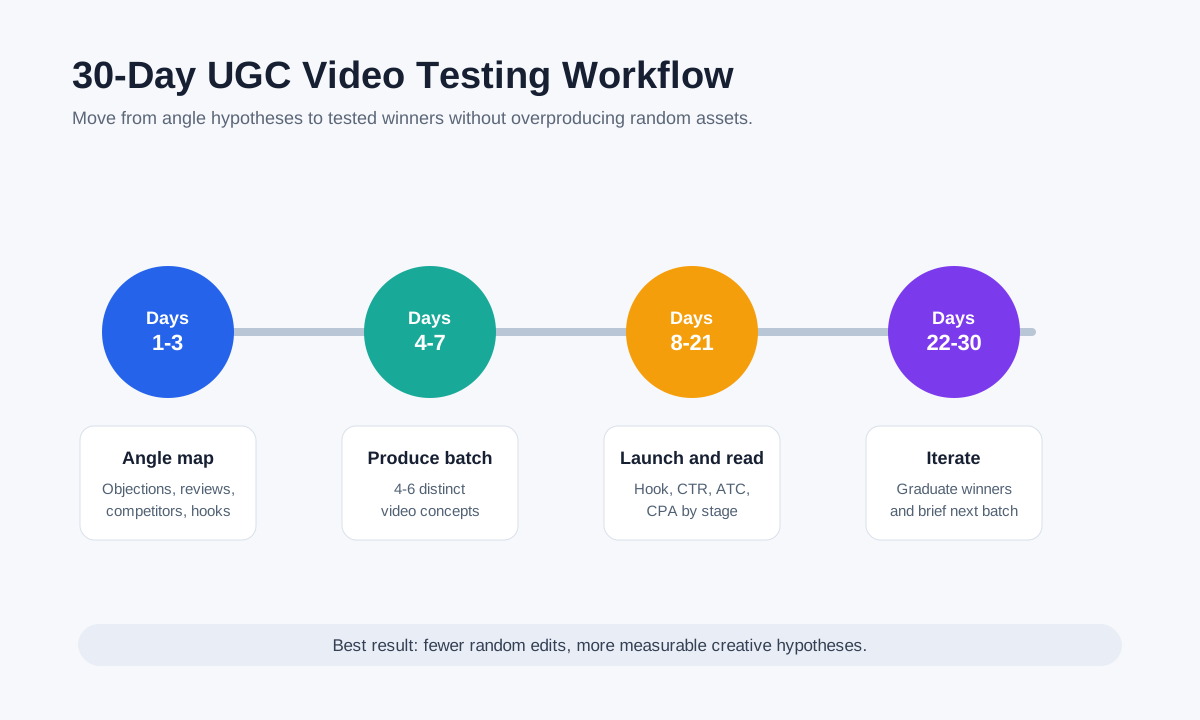
A 30-Day UGC Video Testing Workflow
Use this workflow when you need a repeatable monthly system.
Days 1-3: Build the angle map
Start with buyer objections, not creator availability. Pull inputs from:
- Product reviews and support tickets.
- Product detail page questions.
- Existing winner ads.
- Competitor ad libraries.
- TikTok Creative Center and platform trend examples.
- Comments on organic posts.
- Sales calls or customer interviews.
Create an angle map with 8 to 12 possible ideas, then pick 3 to 5 for the next batch. The goal is not to cover every idea. It is to produce enough variety that a clear signal can emerge.
Days 4-7: Produce the first batch
Produce the first 4 to 6 videos. Keep the product, audience, and offer stable if possible. Change the creative variable you want to learn about.
For example, a skincare brand might test:
- "Why your moisturizer pills under makeup."
- "Three mistakes that make dry patches worse."
- "A customer-style routine after 14 days."
- "A founder explains the ingredient stack."
- "Side-by-side texture demo."
- "Price objection: why one jar replaces two steps."
These videos are meaningfully different. A caption color swap would not be.
Days 8-14: Launch and protect the test
Launch the batch with enough budget concentration to learn. For small accounts, that may mean 4 ads in one clean test campaign. For larger accounts, it may mean separate test ad sets, a dedicated creative testing campaign, or platform-native experiment tools.
Avoid two common mistakes:
- Too many creatives in one low-budget ad set. The platform may favor a predicted winner before most videos receive useful delivery.
- Too many variables at once. If hook, creator, offer, and format all change, you learn that one ad won, but not why it won.
Give the test an observation window. TikTok's Smart Creative documentation describes early observation over 3 to 5 days for differentiated videos. That is a useful reminder: do not judge a new batch after two hours unless the ad is clearly broken.
Days 15-21: Read signals by funnel stage
Do not rank every ad only by purchases. Early funnel signals matter because UGC videos can fail before the product page ever gets a chance.
| Funnel stage | Metric to inspect | What it tells you |
|---|---|---|
| First 3 seconds | Thumb-stop rate or early retention | Whether the hook earns attention |
| Mid-video | 25% and 50% views | Whether the story holds interest |
| Click | CTR and CPC | Whether the promise creates intent |
| Site action | Add-to-cart or checkout start | Whether the landing page and offer match the ad |
| Purchase | CPA, ROAS, MER context | Whether the creative can graduate |
When an ad has strong hook metrics but weak clicks, the opening may be interesting but not commercial. When clicks are strong but add-to-cart is weak, the ad may be overpromising or attracting the wrong buyer. When add-to-cart is strong but CPA is weak, inspect price, offer, shipping, checkout, and retargeting before blaming the video.
Days 22-30: Graduate, iterate, or retire
Every creative should leave the test in one of four states:
| State | Rule | Next action |
|---|---|---|
| Winner | Hits target CPA or creates strong downstream signal | Move into scaling campaign |
| Iteration | Strong hook or CTR, weak conversion | Rewrite promise, proof, or landing page match |
| Learning asset | Did not win, but taught a clear lesson | Store insight in creative library |
| Retire | Low attention and low intent | Stop and avoid near-duplicates |
This is where creative velocity becomes practical. The team should know what to make next because the test produced a learning, not just a spreadsheet of winners and losers.
How Many Ads Should You Test at Once?
Monthly volume and simultaneous volume are different.
For most ecommerce teams:
- Test 2 to 4 videos at once if daily budget is under $100.
- Test 4 to 6 videos at once if daily budget is $100 to $500.
- Test 6 to 10 videos at once if daily budget is $500 to $2,000.
- Use larger pods only when you have enough spend or platform setup to prevent delivery starvation.
If you test 20 videos at once on a low budget, most videos may never get a real chance. If you test only one video at a time, you move too slowly and cannot compare angles under similar market conditions. The middle path is batched testing.
Budget Math for UGC Video Testing
Before creating a video batch, estimate the test budget.
Use this simple formula:
Test budget = number of videos x minimum spend per video
Then define the minimum spend per video based on your business:
| Business type | Suggested minimum spend per video |
|---|---|
| Low AOV impulse product | 0.5x to 1x target CPA |
| Mid AOV ecommerce product | 1x to 2x target CPA |
| High AOV product | 2x to 3x target CPA or use add-to-cart signal |
| New store with no CPA benchmark | Enough for 50 to 100 clicks |
Example: if your target CPA is $35 and you want to test 6 videos, a first useful test budget might be $210 to $420. If you only have $100 available, test fewer videos or use hook and click signals instead of purchase data.
This prevents a common ecommerce mistake: ordering more UGC than the media budget can evaluate.
How to Split Hooks, Creators, and Formats
A balanced 12-video monthly plan should not be 12 random videos. Use a matrix.
| Test layer | Number of variants | Example |
|---|---|---|
| Hook | 4 | Problem, outcome, myth, comparison |
| Creator type | 3 | Founder, customer, creator/demo |
| Proof style | 3 | Review, product demo, before/after |
| Format | 2 | 9:16 UGC and product close-up |
You can combine these into a monthly plan without producing every possible combination. Full factorial testing would explode into dozens of ads. Ecommerce teams usually need a practical matrix, not a lab experiment.
Start with the highest-leverage variable: the first 3 seconds. If the hook fails, the creator's later proof and CTA do not matter.
When Fewer Videos Are Better
More UGC videos are not always the answer. Test fewer videos when:
- You do not have a stable offer yet.
- Your landing page conversion rate is broken.
- Your product page lacks clear images, reviews, price clarity, or shipping clarity.
- Your budget cannot give each video meaningful delivery.
- Your creative ideas are too similar.
- Your compliance risk is high and review cycles are slow.
In those cases, use 3 to 4 videos to validate the core message, then scale production after the offer and product page are stable.
This is especially important for regulated or sensitive categories. A higher creative volume with weak claims review can create policy risk faster than it creates learning.
When More Videos Are Necessary
Increase creative volume when:
- The account has stable conversion tracking and enough spend.
- Winning ads fatigue quickly.
- The same few videos dominate spend.
- You sell multiple SKUs or seasonal products.
- You are entering TikTok, Reels, Shorts, and Feed at the same time.
- Competitors are refreshing angles faster than you.
At that point, a monthly creative plan might include:
- 8 hook tests.
- 6 proof tests.
- 4 creator/persona tests.
- 4 product demo variations.
- 4 platform-native edits.
- 4 winner iterations.
That is 30 UGC-style videos, but it is not chaos. Each asset has a role.
Common Mistakes
Mistake 1: Testing edits instead of concepts
Changing caption color, music, or background is useful only after the concept is proven. Early tests should compare ideas: problems, outcomes, buyer types, proof, and use cases.
Mistake 2: Killing ads before they receive signal
If a video has only a few hundred impressions, you usually know very little. Pause broken ads, but give plausible ads a fair observation window.
Mistake 3: Declaring a winner on cheap clicks
Cheap clicks are useful, but they can hide poor buyer intent. A UGC ad can create curiosity without creating purchases. Always connect creative metrics to landing page behavior.
Mistake 4: Producing videos without a learning log
If nobody records why each ad was made, the next batch becomes guesswork. Keep a simple creative library with hook, angle, creator style, product, platform, spend, signal, result, and next action.
Mistake 5: Linking every result to the platform algorithm
Automated delivery matters, but weak creative strategy still fails. When a test underperforms, inspect the hook, promise, product proof, landing page match, and offer before blaming the buying system.
UGC Testing Checklist
Use this checklist before approving the next batch:
- Every video has one clear hypothesis.
- The batch covers at least 3 distinct angles.
- Each video has a different opening hook or proof style.
- The test budget can support the batch size.
- The platform format is native: 9:16 for Reels, TikTok, and Shorts when relevant.
- Product claims are accurate and review-safe.
- The landing page matches the ad promise.
- Metrics are defined before launch.
- Winners have a graduation rule.
- Learnings are recorded before the next batch is produced.
How ShopShot Fits Into the Workflow
ShopShot is useful when the testing bottleneck is production speed. Instead of waiting for a full creator production cycle for every angle, ecommerce teams can turn product images, product-page information, and hook ideas into short product video ad drafts.
That does not replace strategy. You still need to decide what to test. The best workflow is:
- Pick the buyer objection.
- Write the hook and proof angle.
- Generate a short video draft.
- Export multiple platform versions.
- Launch a controlled batch.
- Feed results back into the next script.
For related planning, read ShopShot's guide to dynamic creative optimization for ecommerce video ads, the UGC videos ecommerce workflow, and the Facebook video ad examples breakdown. If you are building Facebook-specific ads, the Facebook video ad generator is the relevant tool page.
FAQ
Is 3 UGC video ads enough for one month?
Three UGC video ads can be enough for a tiny budget or an early offer test, but it is usually not enough for a serious monthly creative pipeline. Most ecommerce teams should test at least 6 videos per month once they have stable tracking and a clear product page.
Should I test UGC videos on Meta and TikTok separately?
Yes, if the budget allows. The same concept can behave differently on TikTok, Instagram Reels, Facebook Feed, and YouTube Shorts. If budget is limited, test the strongest native 9:16 version first, then adapt winners to other placements.
How long should I let a UGC ad run before judging it?
Use a 3 to 7 day first-read window unless the ad is clearly broken or violates policy. For purchase-based decisions, wait until the ad has enough spend or conversions to compare fairly. For early tests, use hook, retention, CTR, and add-to-cart signals.
How often should ecommerce brands refresh UGC video ads?
Refresh when performance signals show fatigue, not only because the calendar changed. Small accounts may refresh every 2 to 4 weeks. Larger accounts may need weekly creative batches, especially when frequency rises or CPA climbs while the landing page remains stable.
Do AI-generated UGC-style videos count as UGC ads?
They can count as UGC-style creative tests if they use native pacing, human-style hooks, product proof, and accurate claims. Do not present fictional creators as real customers. Keep disclosure, rights, and platform policies in mind.