
Quick Answer
The safest default for TikTok ecommerce product ads is a vertical 9:16 video at 540x960px or higher, exported as .mp4 or .mov, with sound, readable captions, dynamic motion, and all key text or product proof kept inside the safe zone. TikTok's current docs also show a practical split between formats: Spark Ads can inherit organic videos, while Non-Spark in-feed ads should stay launch-safe with short paid-ad durations, strong landing-page consistency, and clear safe-zone planning when anchors or captions are used.
If you only remember one rule, remember this: a TikTok ad passes more reliably when the file specs, the creative layout, and the landing page all tell the same story. A technically valid upload can still underperform or get delayed if the caption, CTA, product proof, or anchor placement does not match the destination page.
For ecommerce teams already building creative inputs, pair this guide with the TikTok Creative Center workflow, the TikTok Shop product-link guide, and ShopShot's TikTok Shop video workflow.
The TikTok Ad Specs That Matter Most
TikTok's current business help and policy docs do not all present the same numbers in the same way, so the safest workflow is to separate "upload can technically work" from "launch-safe paid creative."
Use this baseline table for ecommerce product ads:
| Spec area | Launch-safe default | Why this is the safest choice |
|---|---|---|
| Primary aspect ratio | 9:16 vertical | TikTok recommends vertical for immersive placement and clearer product visibility on mobile. |
| Minimum resolution | 540x960px or higher | Meets current in-feed guidance and avoids blurry PDP screenshots or text. |
| Better production target | 720x1280px or higher | Gives cleaner exports for captions, close-ups, and repurposing. |
| Supported formats | .mp4, .mov, .mpeg, .3gp, .avi depending on placement doc |
.mp4 or .mov is the simplest default for most workflows. |
| File size | Up to 500 MB | Large enough for high-quality short ads, but ecommerce teams should still keep files lean for faster review and handoff. |
| Bitrate | At least 516 kbps; 2,500 kbps shown in reservation specs | A higher-quality export protects product detail, especially for text overlays and small product features. |
| Audio | Required | TikTok policy says ads must contain audio and the sound must be clear. |
| Dynamic motion | Required | Static images should not dominate the ad; TikTok policy limits still-image dependence. |
| Captions | Complete, legible, and consistent with the video | The ad caption and the visual story must align. |
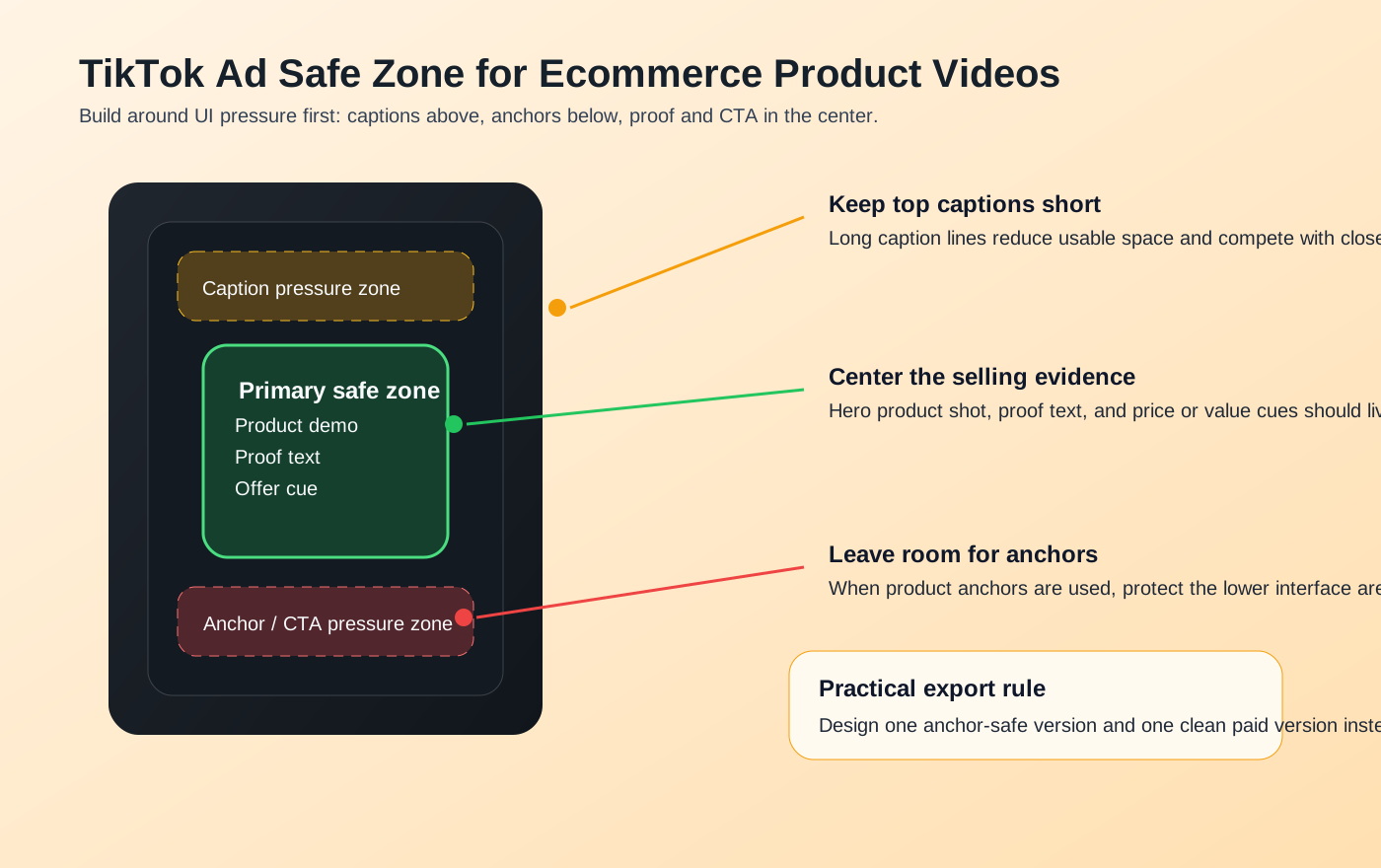
| Safe zone | Keep product, proof text, price cues, and CTA inside the downloadable safe zone | Caption length and anchor usage can shrink usable space. |
The Important Duration Difference
This is the part many generic TikTok specs articles miss.
TikTok's June 2026 auction in-feed spec page says Spark Ads can use organic videos with no duration restriction, and Non-Spark ads can run up to 10 minutes. But TikTok's advertising policy page still says ad duration must be at least 5 seconds and at most 60 seconds. TikTok's reservation in-feed spec page also frames paid video duration as 5-60 seconds and recommends 9-15 seconds.
That means the practical rule is:
| Format situation | What TikTok documents suggest | Safer ecommerce decision |
|---|---|---|
| Spark Ad pulled from existing organic post | Organic video can be longer | Use only if the organic video already performs and still makes sense as an ad. |
| Non-Spark paid in-feed ad | Technical upload specs can allow longer files | Keep paid ecommerce ads inside 5-60 seconds, and treat 9-15 seconds as the default testing range. |
| Product demo with more explanation | Longer video may technically upload | Break the concept into ad, PDP, and retargeting cuts instead of stuffing everything into one paid ad. |
That final recommendation is an inference from TikTok's current docs, not a direct policy sentence. It is the safer operational choice because it lines up the policy page, the reservation spec page, and the way most ecommerce ad tests actually run.
Safe Zone Is Not Optional
TikTok's spec pages and Creative Center guidance both emphasize the safe zone. This matters more for ecommerce than for general brand ads because product anchors, captions, CTA overlays, price text, and proof shots all compete for the same screen space.
If you use anchors, the usable design space shrinks again. TikTok explicitly provides different downloadable safe-zone files for standard in-feed ads and in-feed ads with anchors.
Use this layout rule:
| On-screen element | Best placement rule | Risk if ignored |
|---|---|---|
| Product hero shot | Center-safe and visible from frame one | Product gets hidden behind caption area or interface chrome. |
| Price / discount / offer text | Upper-center or center-safe block | Text becomes unreadable behind UI or gets cropped in preview variations. |
| Proof detail | Mid-frame with enough scale | Texture, ingredient, size, or before-after evidence becomes too small to trust. |
| Shop anchor awareness | Leave lower UI area visually clean | Anchor overlaps the product or CTA story. |
| Subtitles | Keep them concise and above lower UI pressure zones | Long subtitles reduce safe space and compete with anchors. |
For teams using the same creative across TikTok Shop and standard ads, build two versions:
- One version with anchor-safe spacing.
- One version without the anchor pressure, for cleaner paid social reuse.
Captions, Landing Pages, and Product Truth Must Match
TikTok's policy and creative guidance both stress consistency across the ad caption, the video, the display name, and the landing page. For ecommerce sellers, this is where a lot of avoidable review friction starts.
The video says one thing, the caption says another, and the product page shows a third version of the claim. That creates conversion leakage even if the ad is approved.
Use this consistency checklist:
| Surface | Must match | Typical failure |
|---|---|---|
| Caption | Product shown and offer promised | Caption says "50% off" while landing page says "up to 30% off." |
| Display name / account name | Brand or product identity | Ad looks like one brand but lands on a different product family. |
| Product proof | PDP claims, specs, and included items | Video implies waterproofing, ingredients, or results that the page cannot support. |
| CTA | Page destination | "Shop the bundle" lands on a single-product page. |
| Language | Target market and page language | English ad drops users onto a page they cannot read. |
If you need help tightening the creative before export, use the UGC hooks guide and the product video script template. If the issue is broader production planning, use the product video storyboard template.
A Practical TikTok Ad Workflow for Ecommerce Teams
1. Start from the product truth file
Before editing, define the exact SKU, offer, core claim, evidence, and CTA. This should come from the product detail page, reviews, ingredients/specs, and support FAQs, not from guesswork.
2. Choose one ad job
Pick one purpose per cut:
- Hook a cold audience.
- Demonstrate the product.
- Compare against a common alternative.
- Push a limited-time offer.
- Retarget viewers who already know the product.
When one video tries to do all five, the specs may pass but the ad gets weaker.
3. Build for the correct safe zone
If the ad will carry an anchor or shop linkage, design around the anchor-safe version first. Keep product proof large enough that it still works once captions and TikTok UI are added.
4. Export the paid-ad version separately
Do not assume the organic version is automatically the best paid version. Create a paid cut with:
- cleaner opening frames
- shorter subtitle blocks
- stronger product proof in the first three seconds
- a simpler CTA
- fewer low-value filler shots
5. Run a pre-launch QA pass
Check the actual file spec, audio clarity, caption consistency, landing-page match, and visual safe-zone compliance before upload.
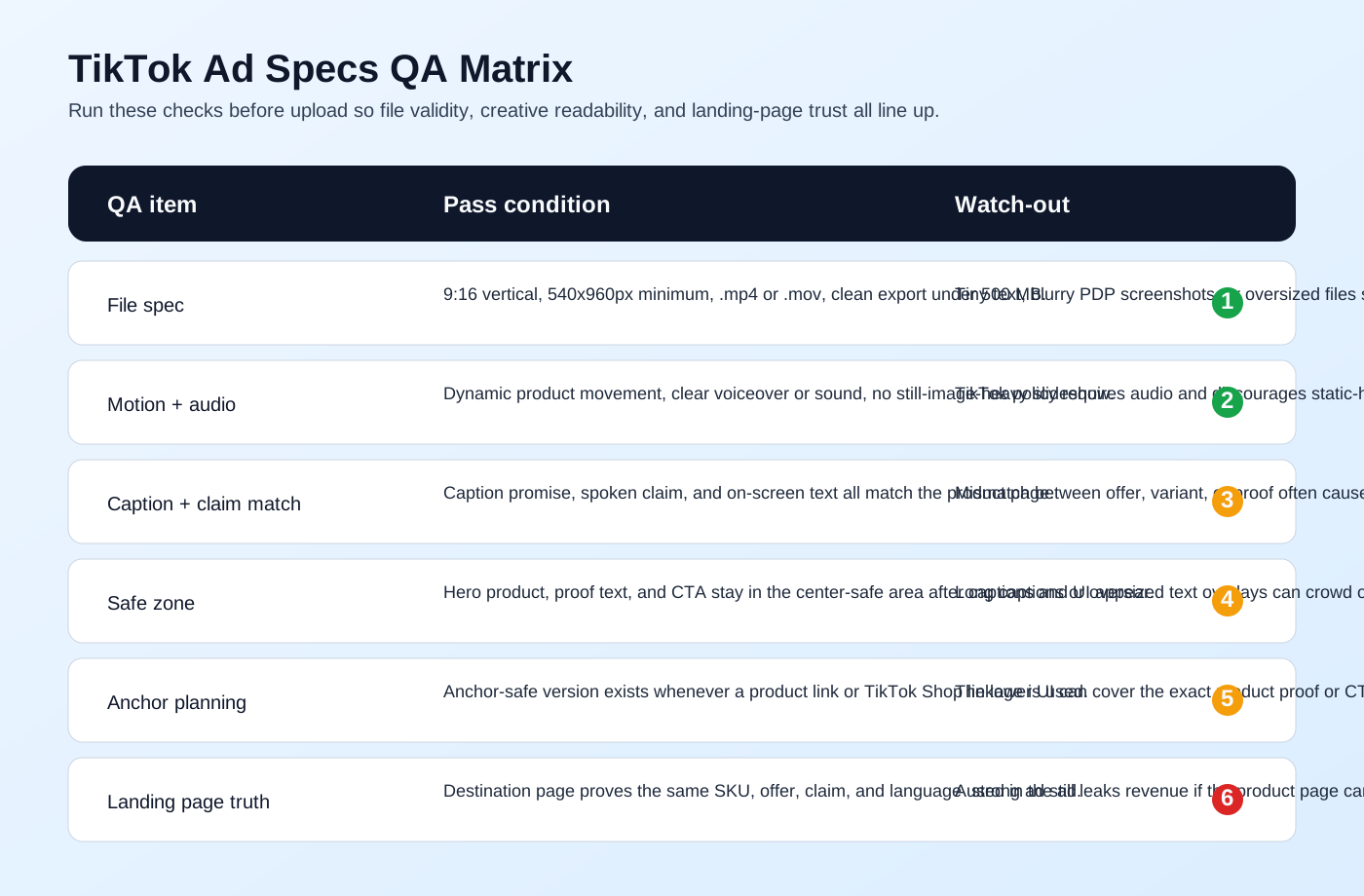
TikTok Ad QA Matrix Before Launch
| QA item | Pass condition | Why it matters |
|---|---|---|
| Aspect ratio | Export is 9:16 unless you intentionally need 1:1 or 16:9 | Vertical protects immersion and avoids wasted crop space. |
| Resolution | At least 540x960px; ideally 720x1280px or higher | Prevents blurry product detail and unreadable overlays. |
| File format | Final deliverable is .mp4 or .mov |
Simplifies cross-team handoff and lowers upload friction. |
| Duration | Paid version stays within 5-60 seconds | Aligns with policy-safe execution. |
| Motion | Video is dynamic, not mostly still images | TikTok policy limits static-heavy ads. |
| Audio | Voiceover, music, or sound cues are present and clear | TikTok requires audio and punishes poor listening experience. |
| Caption consistency | Caption matches the ad's promise and landing page | Reduces approval and trust problems. |
| Safe zone | Product, proof, price cues, and CTA stay inside the correct layout | Protects legibility when captions or anchors appear. |
| Anchor planning | Anchor-safe version exists when product links are used | Keeps the lower UI from covering the offer or product. |
| Landing page match | Page proves the same product, claim, and offer | Converts better and avoids mismatch risk. |
Common Ecommerce Mistakes
Mistake 1: Designing the ad before choosing the destination
If you build the edit first and choose the destination later, the CTA, offer, and proof usually drift apart.
Mistake 2: Treating all TikTok specs pages as interchangeable
TikTok has different spec pages for different ad flows. If you mix Spark, reservation, policy, and catalog guidance without context, you can end up technically compliant but operationally sloppy.
Mistake 3: Using long captions with small product proof
TikTok notes that longer captions shrink the safe zone. If the product shot is already small, the caption can make the creative much harder to read.
Mistake 4: Relying on a static slideshow
TikTok policy says static images should not occupy more than 50% of the ad. A slideshow with tiny zoom moves is still a weak paid creative for most ecommerce tests.
Mistake 5: Reusing the same cut for every placement
The cleanest workflow is one source concept, then platform-specific cuts. TikTok ad creative often needs faster product proof and more careful safe-zone planning than a Shopify PDP clip.
When to Use Spark vs Non-Spark for Ecommerce
| Format | Best use | Limitation to watch |
|---|---|---|
| Spark Ads | Amplify an organic post that already has strong retention, comments, or creator credibility | Organic length and layout may not be ideal for paid conversion. |
| Non-Spark Ads | Launch controlled paid tests with cleaner copy, CTA, and edit pacing | Requires deliberate paid-specific export and spec QA. |
| TikTok Shop-linked ad | Turn product discovery into direct shopping action | Anchor-safe spacing and product-page match become non-negotiable. |
If your organic video is already working, Spark can be the fastest route. If you need tighter control over messaging, offer framing, or product proof, Non-Spark is usually the better starting point.
FAQ
What size should a TikTok ecommerce ad video be?
The safest default is vertical 9:16. TikTok's current in-feed specs list 540x960px or higher as the minimum practical baseline, but 720x1280px or higher is a stronger production target for readable text and product detail.
How long should a TikTok product ad be?
For paid ecommerce ads, keep the main test version within 5-60 seconds and treat 9-15 seconds as the default range for fast creative testing. Longer content may still make sense as organic or Spark material, but not as the core paid cut.
Does TikTok require audio in ads?
Yes. TikTok's current ad policy says ads must contain audio and the audio must not be poor quality.
Can I use square or horizontal video ads on TikTok?
Yes. TikTok policy and spec pages still list 1:1 and 16:9 as supported. But for most ecommerce product ads, 9:16 remains the best default because it uses the screen more effectively and leaves less dead space.
Why does my TikTok ad look fine in editing software but bad after upload?
The usual causes are safe-zone mistakes, overly long captions, weak contrast, blurry exports, or important elements placed too close to where TikTok UI or anchors appear.
Sources Checked
- TikTok Auction In-Feed Ads
- TikTok Reservation In-Feed Ad Specifications (including Reach & Frequency)
- TikTok Advertising Policies: Ad Format and Functionality
- TikTok Creative Center: Creative Guidance
Bottom Line
TikTok ad specs are not just an export checklist. They shape whether your product proof stays visible, whether your caption and landing page stay consistent, and whether anchors or UI elements cover the parts of the creative that actually sell. Use 9:16 paid-safe exports, plan for the safe zone early, keep the product page and ad promise aligned, and treat Spark and Non-Spark as different execution modes rather than the same file with a different toggle.