
An ecommerce video ad testing plan helps you decide what to learn before you spend. Instead of launching five random videos and hoping the platform finds a winner, define one product, one campaign goal, one creative variable, and a simple decision rule. Then create controlled variants, launch them with enough budget to get directional data, and turn the result into the next video batch.
Quick Answer
For a small ecommerce team, the best video ad testing plan is a weekly loop: choose one product or offer, pick one variable to test, create three to five video variants, run them against the same audience and conversion goal, then decide whether to scale, iterate, or stop. Test variables in this order: hook, product proof, offer, format, and CTA. Track early attention metrics like 2-second or 6-second views, but make the final decision with business metrics such as click-through rate, add-to-cart rate, purchases, CPA, and landing-page fit.
If you are unsure how many videos to prepare, start with the UGC video ad testing volume guide. If you need reusable scripts before making variants, use the product video ad script template.
Why Random Creative Tests Waste Budget
Most small ecommerce teams do not fail because they test too little. They fail because every test changes too many things at once.
One ad has a creator hook, a discount offer, a vertical format, and a product demo. Another ad has an AI actor, a testimonial claim, a bundle offer, and a square crop. If the second ad wins, what actually worked? The hook? The format? The offer? The product proof? You do not know, so the next batch becomes another guess.
Use this rule: a video ad test should make one decision easier.
| Bad test question | Better test question | Why it is cleaner |
|---|---|---|
| Which video is best? | Which opening hook gets more qualified viewers? | Focuses the test on first-screen attention |
| Does this product ad work? | Does a demo proof beat a review proof for this SKU? | Tests one product-story choice |
| Should we use AI videos? | Can AI-generated variants match our current CPA after QA? | Tests workflow, not hype |
| Is TikTok better than Meta? | Does the same winning hook survive a Meta crop and CTA? | Separates creative from channel fit |
| Do customers like the offer? | Does free shipping beat 15 percent off for this product? | Isolates offer framing |
Google Ads video experiments recommend starting with a hypothesis and keeping the tested variable tied to the campaign goal. Meta's A/B testing guidance also warns that informal testing can create overlapping audiences, which makes results harder to compare. Treat those platform tools as guardrails: they work best when the creative question is narrow.
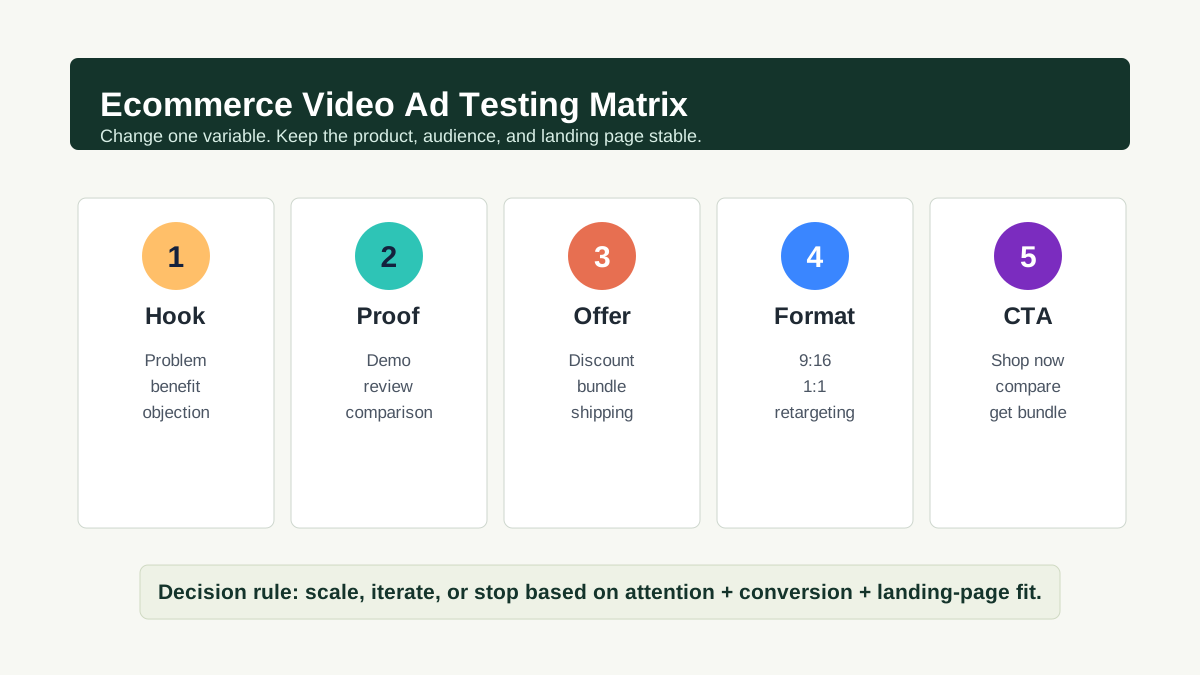
The Five Variables to Test First
For ecommerce video ads, test creative variables in a sequence that matches how a shopper experiences the ad.
| Test order | Variable | What changes | What stays fixed |
|---|---|---|---|
| 1 | Hook | First 1-3 seconds, opening line, first visual | Product, offer, CTA, landing page |
| 2 | Product proof | Demo, close-up, review, comparison, before/after | Hook structure, offer, CTA |
| 3 | Offer | Discount, bundle, free shipping, urgency, guarantee | Product proof and format |
| 4 | Format | 9:16, 1:1, product-first, creator-first, caption style | Core message and offer |
| 5 | CTA | Shop now, compare sizes, get the bundle, view demo | Hook, proof, offer |
Do not begin with ten variables. Start with the one most likely to unlock learning. If videos have weak retention, test hooks. If viewers click but do not buy, test product proof or offer. If one channel performs and another does not, test format and placement fit.
Build a One-Week Ecommerce Video Ad Testing Plan
Use this workflow when you need a practical weekly plan.
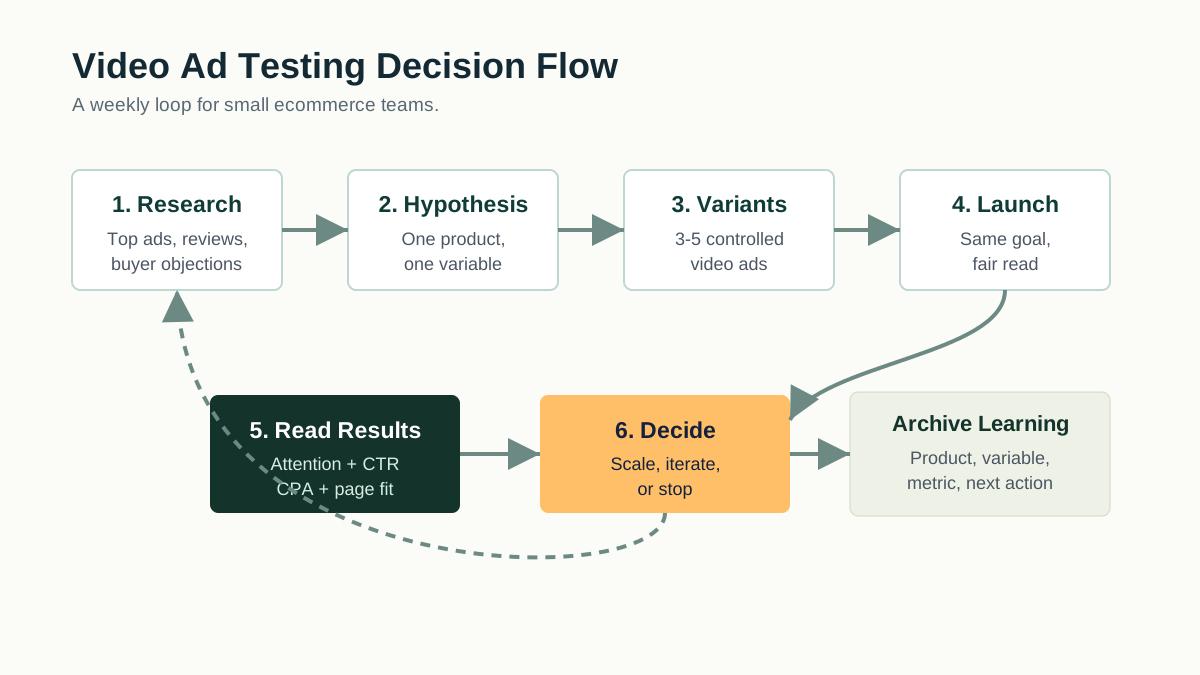
1. Choose One Product and One Goal
Pick a product with enough margin, clear product images, a working product page, and a measurable event. Do not use a test to rescue a product page with broken trust signals, unclear pricing, or weak checkout flow.
Set one primary goal:
| Goal | Good primary metric | Supporting metric |
|---|---|---|
| Find a stronger hook | Thumb-stop rate, 2-second views, 6-second views, view rate | CTR |
| Improve traffic quality | CTR, landing-page views | Bounce or add-to-cart rate |
| Improve conversion | Purchase conversion rate, CPA, ROAS | Add-to-cart rate |
| Validate product proof | Add-to-cart rate, purchase rate | Video completion or CTR |
| Test offer framing | CPA, purchase rate, revenue per click | CTR |
For early creative discovery, attention metrics are useful. TikTok's Top Ads Dashboard can sort examples by reach, CTR, 2-second views rate, and 6-second views rate, which makes it useful for researching hook patterns before you spend. But do not pick a winner only because it gets cheap views. Ecommerce ads still need qualified clicks and purchases.
2. Write a Test Hypothesis
A hypothesis prevents a test from becoming a mood board.
Use this format:
For [product], we believe [creative variable] will improve [metric] because [buyer reason].
We will test [number] variants while keeping [fixed elements] unchanged.
We will choose a winner if [decision rule].
Example:
For a leakproof lunch box, we believe a problem hook will improve CTR because buyers notice spills before they care about features.
We will test four hook variants while keeping product proof, offer, format, and CTA unchanged.
We will choose a winner if one hook produces a lower CPA or at least a clear CTR lift without hurting add-to-cart rate.
This is the point where ShopShot can help: create controlled variants from the same product assets and script structure instead of rebuilding each video manually. If you need a production path, start from ShopShot's AI video generator.
3. Create Three to Five Controlled Variants
Small teams usually do not need twenty ads in the first round. Three to five variants are enough to learn without spreading budget too thin.
For a hook test, keep the rest of the video stable:
| Variant | Opening angle | Example first line |
|---|---|---|
| Problem hook | Name the pain | "Your gym bag should not smell like yesterday's shoes." |
| Benefit hook | Promise the result | "Keep clean clothes separate from sweaty sneakers." |
| Proof hook | Show the mechanism | "This mesh pouch vents moisture while the zipper traps dirt." |
| Objection hook | Address doubt | "It folds flat when you are not using it." |
| Offer hook | Lead with deal | "Bundle two travel pouches before your next trip." |
For a proof test, keep the hook and offer stable:
| Proof type | Best when | Watch-out |
|---|---|---|
| Product demo | The feature is visible | Show the real mechanism accurately |
| Comparison | The alternative is familiar | Do not exaggerate competitor weakness |
| Review proof | Trust is the blocker | Use real review language and avoid fake testimonials |
| Use-case scene | The product solves a specific routine | Keep the scene close to real buyer context |
| Before/after | The result is visual | Avoid unsupported outcome claims |
Set a Budget Rule Before Launch
Testing budget depends on product price, campaign goal, and account history. The practical rule is not "spend as little as possible." It is "spend enough to avoid killing a variant before it has a fair chance."
Use this lightweight planning table:
| Product / account condition | Test style | Budget guardrail |
|---|---|---|
| New account or little conversion history | Directional creative read | Judge hooks with attention and CTR first |
| Existing account with purchases | Conversion-oriented read | Use CPA, purchase rate, and revenue per click |
| High-ticket product | Longer learning window | Do not expect fast purchase volume from tiny spend |
| Low-ticket impulse product | Faster creative read | Watch CTR and add-to-cart quality quickly |
| Seasonal or sale offer | Short test window | Predefine when to stop weak variants |
For a more detailed budgeting model, use the product video budget template. The key is to define a stop rule before the ads launch. If a variant has poor hook retention and weak CTR, stop it. If it has strong CTR but poor conversion, inspect the landing page and offer before blaming the video.
Read the Results Without Fooling Yourself
Creative tests produce noisy data, especially on small budgets. Use a decision table instead of one metric.
| Result pattern | Likely meaning | Next action |
|---|---|---|
| High view rate, low CTR | Hook holds attention but offer is unclear | Test CTA, product proof, or offer frame |
| High CTR, low add-to-cart | Video creates curiosity but page does not match | Check landing page, price, proof, and message match |
| Low view rate, high conversion from clicks | Hook is narrow but qualified | Test a broader hook while keeping proof |
| High add-to-cart, weak purchase rate | Offer or checkout friction | Test offer, shipping, guarantee, or product-page trust |
| Good CPA, weak retention | The ad may be direct-response efficient | Keep it running and test a second scalable angle |
Google video experiments describe directional and conclusive confidence thresholds. In practice, small ecommerce teams often use directional reads to decide the next creative batch, not to make permanent business claims. Keep the language honest: "This hook earned the next test" is safer than "This hook is proven."
Connect Creative Testing to Landing-Page Fit
A video ad can only do part of the work. If the ad promises a bundle, the product page must show that bundle. If the ad uses a durability proof, the page should support it with specs, photos, or reviews. If the video shows a product variant, the landing page should not default to a different color or size.
Run this QA before scaling a winner:
| QA item | Pass condition |
|---|---|
| Product match | The video, landing page, and checkout show the same product |
| Claim support | Every performance, material, durability, or result claim is supported |
| Offer match | Price, discount, bundle, and shipping terms match the page |
| Visual match | First product image matches the ad's hero product |
| CTA match | The ad CTA leads to the expected action |
| Mobile load | The landing page loads quickly enough for paid traffic |
| Review proof | Social proof used in the ad is real and available on the page |
If this step fails, do not create more video variants yet. Fix the product page, or the test will punish the video for a page problem.
Use Platform Tools for the Right Job
Each platform's testing and research tools answer a different question.
| Tool or source | Best use | Do not use it for |
|---|---|---|
| TikTok Top Ads Dashboard | Researching hooks, categories, and second-by-second engagement moments | Copying another brand's ad directly |
| Meta A/B testing or creative testing | Comparing creative variants with less audience overlap than informal tests | Testing too many variables at once |
| Google video experiments | Testing video assets, campaign arms, and success metrics such as CTR, CPV, view rate, or conversions | Declaring a universal winner from one campaign |
| Internal ecommerce analytics | Checking product-page conversion, add-to-cart, revenue per click, and offer match | Diagnosing creative attention alone |
| ShopShot production workflow | Generating controlled video variants from product assets and scripts | Replacing final product-accuracy review |
For broader creative-variant strategy, read the dynamic creative optimization guide. For tool selection, compare the best AI video ad generators.
A Simple 30-Day Testing Calendar
Use this schedule if you need a repeatable plan.
| Week | Main test | Output |
|---|---|---|
| 1 | Hook test for one product | One winning or learnable hook angle |
| 2 | Product proof test using the best hook | Demo, review, comparison, or use-case proof direction |
| 3 | Offer or CTA test | Stronger conversion message |
| 4 | Format and placement adaptation | Vertical, square, or retargeting version for the best concept |
Archive every test with four notes:
- Product and offer tested.
- Variable changed.
- Metrics used.
- Decision and next action.
This archive becomes your creative memory. The next time you launch a product, you will know which hooks, proof types, and offers usually earn a second test.
Common Mistakes
The first mistake is changing the hook, offer, product proof, and format in one test. That makes the result hard to use.
The second mistake is killing variants based only on views. A cheap view is not a purchase.
The third mistake is scaling an ad before checking the landing page. Message mismatch can make a strong video look weak.
The fourth mistake is copying competitor ads from research tools. Use competitor ads to find patterns, then create original product-specific variants.
The fifth mistake is not documenting the result. A test that is not recorded becomes another opinion in the next meeting.
FAQ
How many ecommerce video ads should I test at once?
Start with three to five variants when budget is limited. That is enough to compare hooks or proof styles without spreading spend too thin. Larger accounts can test more variants, but they still need a clear hypothesis and decision rule.
What should I test first in a product video ad?
Test the hook first if people are not watching or clicking. Test product proof if people click but do not add to cart. Test the offer or CTA if people show interest but the cost per purchase is too high.
How long should I run a video ad test?
Run it long enough to get a fair read for your goal and budget. Platform experiment tools may provide confidence signals, but small teams often use directional results to decide the next creative batch. Define your stop rule before launch.
Can AI-generated videos be used in an ecommerce ad test?
Yes, if each video is reviewed for product accuracy, claim support, offer match, and platform fit. AI-generated variants are useful for testing hooks and angles, but the final claims still belong to your brand.
What metrics matter most for ecommerce video ad testing?
Use attention metrics for early creative reads, CTR for traffic quality, add-to-cart rate for product interest, and CPA or purchase rate for business decisions. Do not rely on one metric alone.
Sources Checked
- Google Ads Help: Create a video experiment
- Meta Business Help Center: About A/B testing
- Meta Business Help Center: About creative testing
- Meta Business Help Center: About experiments
- TikTok Ads Help: How to use the Top Ads Dashboard
- TikTok Creative Center / TikTok One
Conclusion
An ecommerce video ad testing plan should make creative decisions easier, not just produce more ads. Start with one product, one goal, and one variable. Create controlled variants, run a fair test, check the landing page, and record the result. The best outcome is not just one winning ad. It is a repeatable system for making the next batch smarter.