
Quick Answer
Video ad creative fatigue happens when an audience has seen the same creative pattern too many times: the same opening frame, hook, product proof, creator style, offer, or call to action. For ecommerce teams, the fix is not always "make more ads." First identify where performance is dropping, then refresh the smallest meaningful part of the video ad.
If attention metrics fall first, refresh the opening hook, first frame, or pacing. If clicks fall, change the promise or proof. If clicks stay stable but purchases weaken, inspect landing page match, offer, price, shipping, and retargeting before blaming the video. A good fatigue workflow turns one winner into controlled variants, not a pile of near-duplicate ads.
What Creative Fatigue Means in Ecommerce Video Ads
Creative fatigue is the performance decline that appears after a creative pattern stops feeling new to the audience. It often shows up as lower thumb-stop rate, weaker view rate, lower CTR, rising CPC, rising CPA, or a smaller share of spend going to a once-dominant winner.
In ecommerce, fatigue can arrive faster than in slower B2B campaigns because the audience pools are often smaller and the same product promise is served repeatedly across prospecting, retargeting, Reels, TikTok, YouTube Shorts, and feed placements. A skincare product, supplement, gadget, or apparel SKU may have only a few obvious objections and proof points. Once the same buyer sees the same before-and-after claim, unboxing, creator face, or price anchor several times, the ad becomes easy to ignore.
That does not mean every decline is creative fatigue. A video ad can drop because:
- The audience is saturated.
- The offer is no longer competitive.
- The landing page does not match the ad promise.
- Inventory, shipping, price, or reviews changed.
- The platform is reallocating delivery.
- A new competitor entered the auction.
- Tracking or attribution changed.
The practical question is not "Is the ad old?" The practical question is: "Which part of the funnel stopped responding, and what is the smallest creative change that can restore a useful signal?"
How to Diagnose Fatigue Before You Refresh
Use metrics by funnel stage. Do not judge every ad only by ROAS, because a creative problem can appear long before the checkout step.
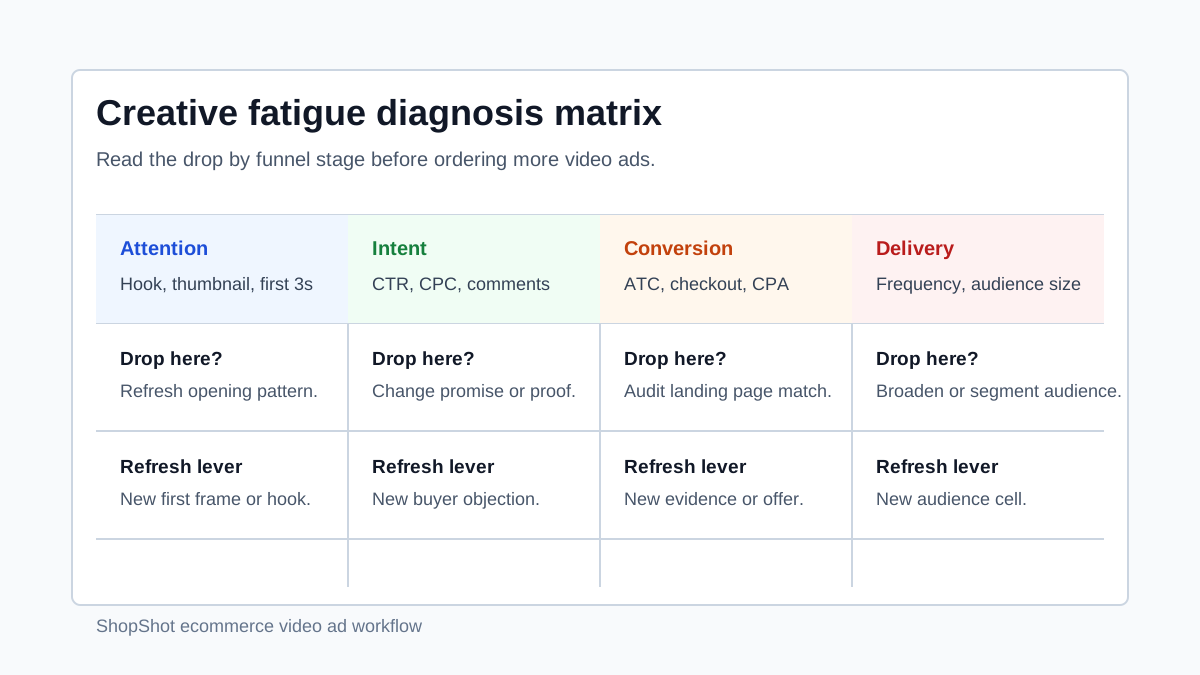
| Signal pattern | Likely problem | What to inspect first | Better next action |
|---|---|---|---|
| Lower 3-second views or thumb-stop rate | Attention fatigue | Opening frame, first line, pattern similarity | Refresh hook, thumbnail, first shot, creator opening |
| Stable early views, lower CTR | Promise fatigue | Product claim, buyer objection, CTA, offer framing | Change the angle or proof, not just the edit |
| Stable CTR, lower add-to-cart | Landing page mismatch | PDP headline, price, reviews, shipping, product media | Align page proof with the ad promise |
| Stable add-to-cart, worse CPA | Offer or checkout issue | Discount, bundles, shipping, stock, checkout friction | Fix commercial friction before reshooting |
| High frequency and shrinking reach | Audience saturation | Audience size, exclusions, retargeting windows | Segment or expand audience before judging creative |
| Spend collapses to one ad | Delivery concentration | Variant similarity, budget, learning setup | Build more differentiated variants |
Google Ads guidance for video campaigns recommends looking at trends rather than point-in-time view rate, and it specifically suggests rotating a few ads to avoid ad fatigue. That is a useful operating principle: fatigue is a trend diagnosis, not a one-day panic.
Creative Fatigue vs Audience Saturation
Ecommerce teams often confuse creative fatigue with audience saturation. The symptoms can look similar, but the fixes are different.
| Question | Creative fatigue | Audience saturation |
|---|---|---|
| What is wearing out? | The message or visual pattern | The reachable buyer pool |
| What usually drops first? | Attention, view rate, CTR, comments | Reach quality, frequency, incremental conversions |
| Best first fix | Refresh creative angle or proof | Expand, segment, or rebuild audience strategy |
| Risk if misdiagnosed | Producing too many random videos | Burning a small audience with more versions |
If the same concept wins again when shown to a new audience, the old audience may be saturated. If the concept fails across fresh audiences, the creative pattern probably needs a stronger refresh.
The Ecommerce Refresh Rule
Do not rebuild the whole ad until you know what failed. A refresh should preserve the learning and change the tired variable.
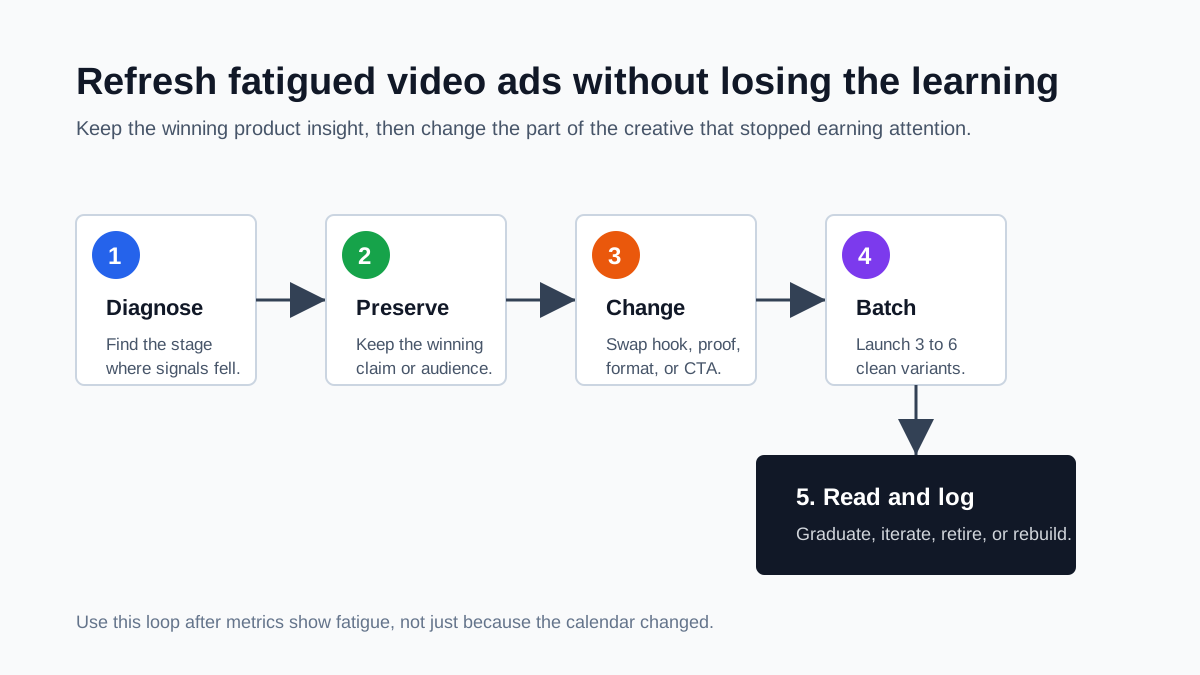
Use this rule:
Refresh the first failed signal, not the whole video.
If the first failed signal is attention, change the first 3 seconds. If the first failed signal is intent, change the promise, proof, or CTA. If the first failed signal is conversion, check the product page and offer before producing more ads.
This is where AI-assisted production can help. A tool like ShopShot can turn product images, product page inputs, and a known buyer objection into multiple video drafts. The important part is the strategy: each variant should test a clear hypothesis, not simply create more motion.
What Counts as a Real Creative Refresh?
A new export is not automatically a new creative. A new crop, caption color, or background music track may help after a concept is proven, but it rarely fixes concept-level fatigue.
| Weak refresh | Stronger refresh | When to use it |
|---|---|---|
| Same video with a new caption color | New first frame and first sentence | Attention drop |
| Same creator, same hook, new music | Same proof, new creator type | Creator fatigue |
| Same demo with a shorter cut | New product proof sequence | Proof fatigue |
| Same offer text in a new template | New offer frame or objection angle | CTR drop |
| Same testimonial with a new crop | New customer situation or use case | Retargeting fatigue |
| Same CTA at the end | Earlier CTA plus product benefit | Click intent drop |
For ecommerce product videos, the highest-leverage refreshes are usually:
- The first frame.
- The first spoken or written hook.
- The buyer problem.
- The proof point.
- The product demo order.
- The creator or presenter style.
- The offer frame.
- The CTA.
Changing all eight at once creates a new ad, but it also destroys the learning trail. Change one or two high-leverage variables first.
A Practical Fatigue Diagnosis Workflow
1. Pull seven to fourteen days of trend data
Do not judge creative fatigue from a single bad day. Pull enough data to compare a recent period against the prior period. For low-spend accounts, use directional signals such as views, CTR, CPC, and add-to-cart. For higher-spend accounts, include CPA, ROAS, frequency, and audience-level performance.
For related metric definitions, use ShopShot's video ad metrics guide.
2. Mark the first signal that declined
Look for the earliest stage where the ad stopped working:
- First frame or hook: 3-second views, thumb-stop rate, view rate.
- Message intent: CTR, CPC, save/share/comment quality.
- Product page intent: add-to-cart, checkout start, landing page engagement.
- Purchase: CPA, ROAS, contribution margin, repeat conversion quality.
The first failed signal tells you where to refresh.
3. Compare against sibling ads
If all ads dropped together, the issue may be offer, seasonality, tracking, competition, or audience quality. If only one once-winning video dropped while other ads stayed stable, creative fatigue is more likely.
4. Check frequency and audience size
High frequency does not prove fatigue by itself, but it raises the risk. A narrow retargeting pool can fatigue a winner quickly. A broad prospecting audience may need a different diagnosis because delivery can shift before the creative is truly stale.
5. Decide: refresh, iterate, retire, or rebuild
Every fatigued ad should leave the review in one of four states:
| State | Use when | Next action |
|---|---|---|
| Refresh | Core concept still works, attention is falling | Change hook, first frame, pacing, or thumbnail |
| Iterate | Some funnel signals are strong, others weak | Keep the winner element and change the weak element |
| Retire | Attention and intent both failed | Stop near-duplicates and log the lesson |
| Rebuild | Offer, audience, or product proof changed | Create a new concept from the new business reality |
Refresh Ideas by Funnel Stage
If attention is falling
Refresh the first 3 seconds. TikTok's creative guidance emphasizes a strong hook, early value proposition, vertical orientation, captions or text overlays, and native-feeling creative. For a product video, that means the opening should show a buyer-relevant problem or result before the viewer decides to scroll.
Try:
- A problem-first opening: "Why this keeps leaking in your gym bag."
- A result-first opening: "The 10-second setup before every trail run."
- A comparison opening: "The old pouch vs the spill-proof one."
- A proof opening: "What changed after 30 washes."
- A product-in-use opening instead of a package shot.
If click intent is falling
The hook may still earn attention, but the promise no longer creates commercial curiosity. Keep the opening format and change the reason to click.
Try:
- A different buyer objection.
- A sharper use case.
- A clearer price or bundle frame.
- A review quote that addresses hesitation.
- A more concrete product demo.
- A CTA that matches the next page.
If conversion is falling after clicks
Do not rush into video production. Check whether the ad promise is still true on the landing page. If the ad says "fits under a stroller," the product page should show that proof. If the ad says "gift-ready," the page should show packaging, shipping dates, and returns.
For broader testing setup, see the ecommerce video ad testing plan.
If you are building a larger variant system across hooks, offers, and audiences, pair this workflow with ShopShot's guide to dynamic creative optimization for ecommerce video ads.
If retargeting is wearing out
Retargeting fatigue often happens because the same proof is shown repeatedly to people who already know the product. Do not repeat the prospecting ad forever. Rotate proof depth by audience temperature.
| Retargeting audience | Better video refresh |
|---|---|
| Product page viewers | Product demo, size, material, comparison |
| Cart abandoners | Shipping, returns, bundle, urgency, guarantee |
| Past buyers | Accessory, replenishment, upgraded use case |
| Engaged video viewers | Stronger product proof and CTA |
| Existing customers | New SKU, seasonal use, gift angle |
ShopShot's product video retargeting guide covers audience-to-creative matching in more detail.
How Often Should Ecommerce Brands Refresh Video Ads?
There is no universal refresh schedule. The right cadence depends on spend, audience size, product category, placement, and how similar your ads look.
| Situation | Suggested operating cadence | Why |
|---|---|---|
| Small prospecting budget | Review every 2 weeks | Daily noise can mislead decisions |
| Narrow retargeting pool | Review weekly | Frequency can rise quickly |
| Seasonal promo | Refresh before offer fatigue | Calendar changes buyer context |
| High-spend single SKU | Produce weekly test batches | One winner can absorb spend fast |
| Multi-SKU catalog | Rotate by SKU and audience | Product variety reduces repetition |
| Evergreen winner | Refresh only when signals slip | Do not disturb a healthy winner |
The best rule is signal-based: refresh when the same creative pattern is losing attention or intent while the product, audience, and landing page remain stable.
How Many Variants Should You Launch?
Google suggests rotating a small number of ads in and out of the auction to avoid fatigue. For ecommerce operators, that usually means a practical batch, not dozens of uncontrolled versions.
| Account size | Practical refresh batch | Notes |
|---|---|---|
| Under $100/day | 2 to 4 variants | Keep differences obvious |
| $100 to $500/day | 4 to 6 variants | Test hook and proof separately |
| $500 to $2,000/day | 6 to 10 variants | Use cleaner audience or campaign structure |
| Higher spend | Dedicated creative testing pods | Keep a learning log and naming system |
If your media budget cannot give each variant enough signal, reduce the batch. More creative is only useful when the account can learn from it.
A Simple Naming System for Fatigue Tests
Use names that make the test readable later:
SKU_Audience_Hook_Proof_Format_Date
Example:
TravelBottle_Retargeting_LeakProblem_SinkDemo_9x16_2026-07
This matters because creative fatigue is pattern fatigue. If the team cannot see which hook, proof, or audience each ad used, the next batch becomes guesswork.
How AI Video Tools Fit Into Creative Refresh
AI video tools are useful when the bottleneck is variant production. They are not a substitute for diagnosis.
A practical ShopShot workflow looks like this:
- Identify the first failed signal.
- Choose one variable to refresh.
- Keep the product, offer, and audience stable.
- Generate 3 to 6 controlled video drafts from the same product images.
- Export native formats for TikTok, Reels, Shorts, or Facebook.
- Launch the batch with clear names.
- Log the learning before creating the next batch.
If you need a production starting point, use the AI video generator. If the refresh is Facebook-specific, the Facebook ads tool page is the relevant ShopShot route.
Common Mistakes
Mistake 1: Calling every decline fatigue
Creative fatigue is only one explanation. Check offer, tracking, inventory, landing page, audience, and seasonality before reshooting.
Mistake 2: Making near-duplicates
Ten ads with the same opening, same creator, same proof, and same CTA are not ten meaningful tests. They are one tired pattern in different clothes.
Mistake 3: Changing too many variables
If hook, creator, proof, product, format, offer, and CTA all change, you may find a winner, but you will not know why it won.
Mistake 4: Refreshing healthy winners too early
Do not kill a working ad just because a calendar says it is old. Refresh when signals show decline or when the business context changes.
Mistake 5: Forgetting product proof
Fatigue can be a proof problem. If every ad repeats the same claim, create new evidence: comparison, review, demo, use case, size context, material test, or customer objection.
Creative Fatigue Checklist
Before producing the next batch, confirm:
- The target audience and product page are still valid.
- The first failed signal is identified.
- Frequency and audience size were checked.
- The current winner's useful learning is preserved.
- The next variants change one or two meaningful creative variables.
- Each variant has a unique hypothesis.
- The refresh batch size matches the available budget.
- Internal naming makes hook, proof, format, and audience visible.
- Product claims are accurate and review-safe.
- Learnings are logged before the next production cycle.
FAQ
What is video ad creative fatigue?
Video ad creative fatigue is a decline in ad response caused by repeated exposure to the same creative pattern. In ecommerce, that pattern may be a hook, first frame, creator style, product proof, offer, or CTA.
How do I know if my ecommerce ads are fatigued?
Look for trend declines in attention, CTR, CPC, CPA, ROAS, or delivery concentration after the product, offer, audience, and tracking remain stable. Identify the first funnel stage that dropped before choosing a fix.
Should I make new videos or edit existing winners?
Start by editing the failed variable. If attention dropped, refresh the opening. If intent dropped, change the promise or proof. Rebuild from scratch only when the core concept, offer, or audience no longer fits.
How often should I refresh product video ads?
Refresh based on performance signals, not a fixed calendar. Narrow retargeting pools may need weekly review, while broader prospecting campaigns may only need new variants when trend data shows fatigue.
Can AI-generated video variants help with fatigue?
Yes, if the variants test clear hypotheses. AI video generation can speed up hook, proof, format, and CTA variations, but it does not replace diagnosis, accurate claims, or landing page alignment.
Sources Checked
- Google Ads Help: Tips for optimizing your Video campaign
- TikTok Ads Manager: Creative best practices for performance ads
- TikTok Ads Manager: About Smart Creative
- TikTok for Business: Creative optimization for SMBs
- Amazon Ads: How to prevent and cure creative ad fatigue
- Think with Google: Creative best practices for YouTube ads
Meta's official creative fatigue help result was checked, but the page redirected to login during this run, so the article does not rely on it as a primary cited source.