
Quick Answer
Product video localization means adapting an ecommerce video ad so the buyer in each market sees the right language, proof, offer, currency, subtitle, voiceover, and landing page. Do not only translate the words. Keep the approved product claim stable, rewrite the hook for the market, review subtitles on mobile, match the localized landing page, and export a separate version for each platform and language.
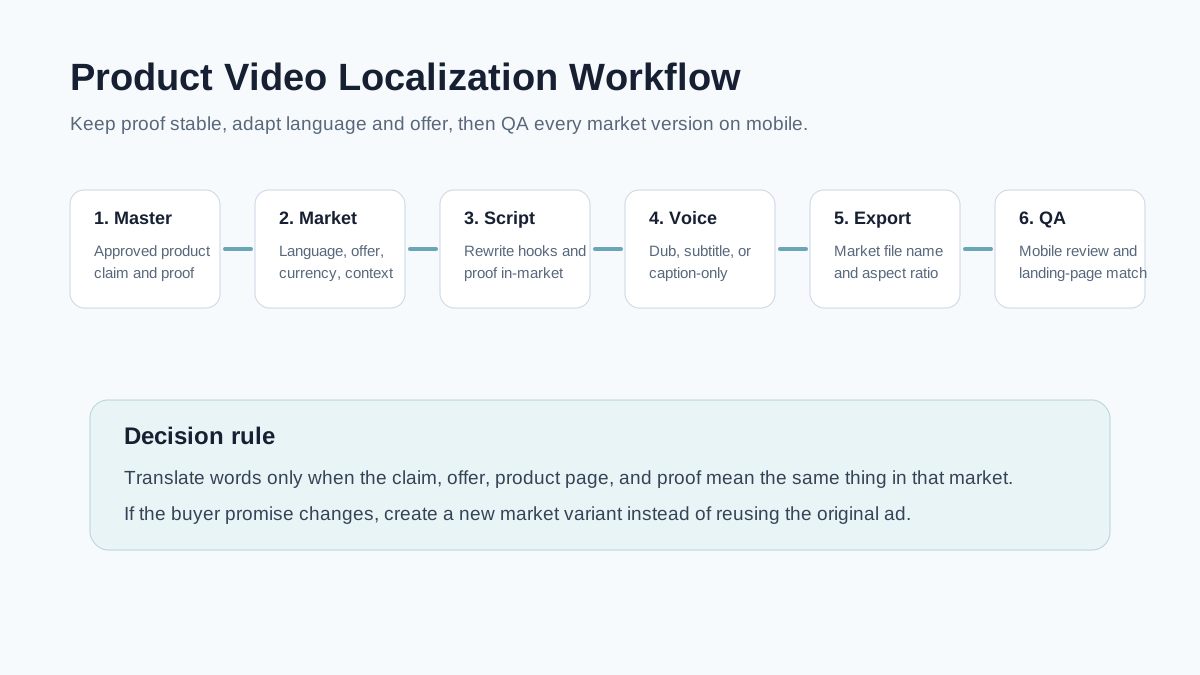
If you already have one winning product ad, localization is one of the cleanest ways to expand it without rebuilding every creative from zero. Start from the approved master, then use ShopShot's AI video generator to create controlled variants for the markets that actually need different language, subtitles, voiceover, proof order, or CTA.
Why Product Video Localization Is Not Just Translation
A translated video can still fail if the buyer promise changes. A skincare claim may need softer wording in one market. A shipping offer may be true in the United States but wrong in Germany. A discount may use a different currency, tax assumption, or deadline. A voiceover may sound fluent while the on-screen proof still shows English packaging, inches instead of centimeters, or reviews that do not match the target market.
For ecommerce ads, localization has five layers:
| Layer | What changes | What should stay stable |
|---|---|---|
| Language | Hook, subtitles, captions, voiceover, CTA | The approved product claim |
| Market context | Currency, shipping, sizing, season, pain point | Product identity and proof |
| Creative format | Aspect ratio, safe zones, captions, audio mix | Core story and product visibility |
| Landing page | Localized page, offer, return policy, proof | Same product and same promise |
| Platform delivery | Language targeting, multilingual features, captions | No misleading mismatch |
Google Ads language targeting, Meta multilingual ad features, and TikTok translation tools can help distribute localized ads, but they do not replace product review. The platform can decide who sees a version; your team still owns whether the localized product promise is accurate.
When Ecommerce Teams Should Localize Product Videos
Localize product videos when the new market changes how a buyer understands the offer. If the same English video is already clear, localization may not be the first priority. If the ad depends on spoken explanation, subtitles, social proof, price, shipping, or cultural timing, localization becomes a launch-readiness check.
Strong localization candidates:
| Situation | Why localization helps | Example |
|---|---|---|
| Cross-border Shopify or Amazon sales | Buyers need local currency, shipping, and return clarity | US product ad adapted for Canada, Germany, and France |
| TikTok Shop or social commerce expansion | Short videos need native hooks and subtitles | English creator ad adapted for Spanish-speaking buyers |
| High-consideration product demos | Details are easy to misunderstand | Beauty device, home appliance, baby product, fitness gear |
| Seasonal campaigns | Timing and offer language vary by market | Holiday bundles, summer travel, back-to-school |
| Retargeting campaigns | Objections differ by market | Shipping time, warranty, sizing, payment methods |
Weak localization candidates:
- A broad brand video with no current paid distribution plan.
- A product with no localized checkout or landing page.
- A video where all proof is embedded in English screenshots that cannot be edited.
- A regulated product claim that has not been reviewed for the target market.
For campaign sequencing, pair localization with the product video export settings guide so each market version has a clean file name, aspect ratio, caption layer, and review path.
Product Video Localization Workflow
Use this workflow before turning one master ad into five language variants.
1. Freeze the Approved Master Claim
Before translation, write down the exact claim the original ad is allowed to make. Include the product benefit, proof source, offer, CTA, and landing page.
Example:
| Field | Approved master |
|---|---|
| Product | Portable blender |
| Claim | Blends one smoothie bottle for commute or gym use |
| Proof | Demo with fruit, water, and finished smoothie |
| Offer | 15% off first order in US store |
| CTA | Shop the bottle blender |
| Landing page | English PDP with same product and offer |
This prevents a translator, AI dubbing tool, or creative editor from improving the claim into something the product page does not support.
2. Decide What Needs Full Localization
Not every element needs the same amount of work. Sort the video into three buckets.
| Element | Translate | Localize | Rebuild |
|---|---|---|---|
| Basic benefit | Usually yes | If idiom or context changes | Rarely |
| Voiceover | Yes if spoken | Yes for tone and pacing | If actor or accent is wrong |
| Subtitles | Yes | Yes for length and readability | If burned-in text blocks are too dense |
| Offer | Never blindly | Always verify | Rebuild if market offer differs |
| Customer quote | Only with permission | Often | Rebuild if the quote is not valid locally |
| Product demo | Usually stays | Add metric units if needed | Rebuild if packaging, plug, sizing, or legal display differs |
Translation changes language. Localization changes the buyer's context. Rebuild only when the original footage creates a mismatch.
3. Rewrite the Hook for the Market
The first two seconds should sound natural in the target market. Do not force a literal translation if the phrase is awkward, too long for captions, or culturally flat.
| English hook | Literal risk | Localized approach |
|---|---|---|
| "Messy cables again?" | May not fit all grammar patterns | Use a short local phrase for the visible problem |
| "This is a game changer" | Generic and overused | State the specific product result |
| "Only $29 today" | Currency and offer may be wrong | Use local price or remove price from video |
| "Perfect for dorm rooms" | Market may not use that housing term | Replace with a local use case |
For performance testing, keep one variable stable. If you localize the hook, do not also change the product demo, CTA, offer, music, and landing page in the same first test. Otherwise, you will not know what changed performance.
Subtitles, Captions, and Voiceover
Localized product videos usually need at least one of these: native subtitles, a dubbed voiceover, or a caption-only version. The right choice depends on the product, the platform, and the market.
| Format | Best for | Watch-outs |
|---|---|---|
| Native subtitles | Fast social ads, sound-off viewing, simple demos | Subtitle length can cover product details |
| Dubbed voiceover | Demo videos where explanation matters | Needs review for tone, timing, pronunciation |
| Caption-only version | Retargeting, simple offer ads, UGC-style clips | Must be readable without audio |
| Re-shot narrator | Trust-heavy products or regulated categories | Costs more and needs release/usage rights |
TikTok Ads Manager currently includes multilingual and translation features in several products, including its Multilingual tool, Spark Ads captions/translations, and Symphony Creative Studio translation and dubbing. Those official docs also show real limitations: availability can depend on placement, campaign type, region, objective, ad format, or whether the creative is AI-generated. Treat platform automation as a distribution helper, not as final copy approval.
For subtitled product ads, use the product video captions QA guide after translation. A perfect translation can still fail if the line is too long, too low in the frame, or too small on a phone.
Market-by-Market QA Matrix
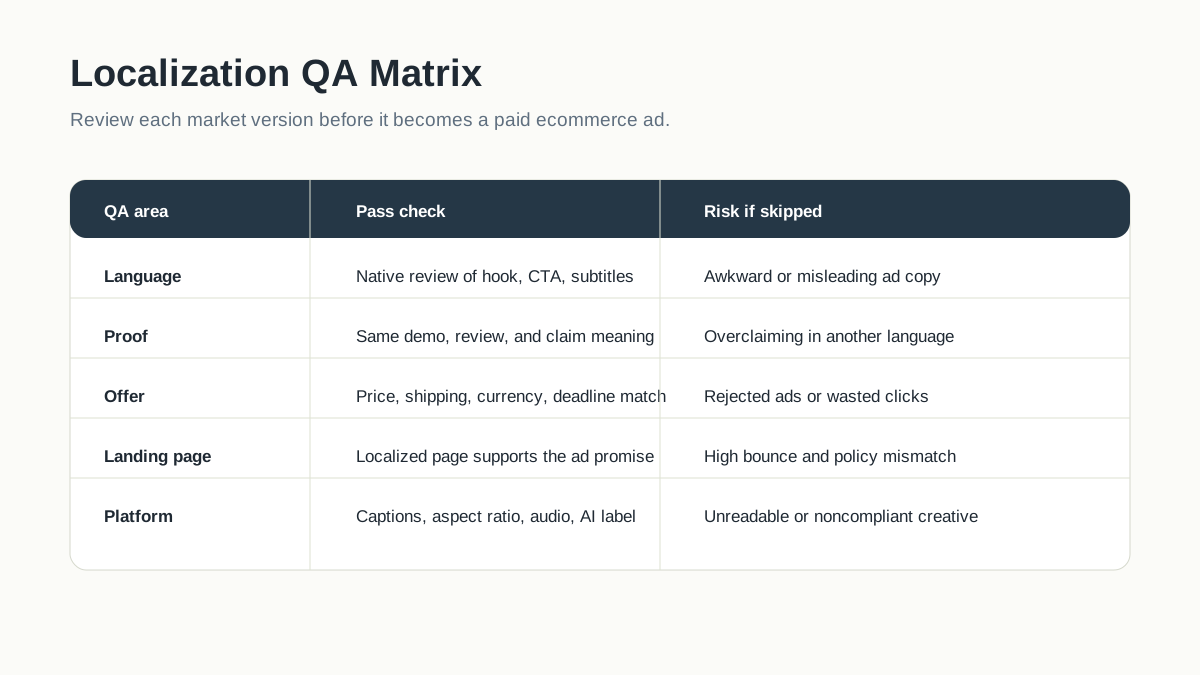
Use this table before uploading localized product videos.
| QA area | Pass check | Failure signal |
|---|---|---|
| Language | Native speaker confirms hook, CTA, subtitles, and voiceover | Literal translation sounds odd or changes meaning |
| Product proof | Demo supports the localized claim | Video says one thing, product page proves another |
| Offer | Currency, discount, shipping, tax, and deadline are correct | Buyer clicks into a different offer |
| Landing page | Localized page matches language and promise | Ad is localized, page is not |
| Platform fit | Aspect ratio, duration, audio, captions, AI label, and safe zones checked | Text is covered, audio is unclear, policy mismatch appears |
| File control | Market code and language are in the file name | Team uploads the wrong language version |
The landing page is the most common weak point. A localized video ad that sends buyers to an English-only page can still waste budget. If the store is on Shopify, Shopify's Translate & Adapt app and Shopify Markets workflow are relevant because they connect product-page language and market adaptation with the shopping experience. The video should not promise a localized buying journey that the store cannot support.
For page consistency, use the product video landing page checklist before scaling spend.
How to Name and Export Localized Video Files
Use a file naming convention that prevents accidental uploads.
Recommended format:
brand-product-market-language-platform-ratio-version-date.mp4
Example:
bottle-blender-ca-fr-tiktok-9x16-v02-2026-07-26.mp4
Keep a simple version log:
| Version | What changed | Who approved |
|---|---|---|
| v01 | Direct translation, subtitle timing | Localization reviewer |
| v02 | Rewritten hook, local price removed | Paid media lead |
| v03 | Voiceover replaced, CTA shortened | Market owner |
This matters because localized ads multiply quickly. A three-market campaign with two hooks, two voiceover options, and two aspect ratios becomes 24 files before retargeting variants.
Platform Notes for Localized Product Ads
Google Ads and YouTube
Google Ads language targeting helps advertisers reach people based on language signals across Google products and third-party sites. For ecommerce video ads, that means the targeting setting and the creative language should be planned together. A Spanish video with English product-page proof is not a localization strategy.
For YouTube-style product videos, keep the first scene visual enough to understand without perfect audio. Use native subtitles for product claims, avoid tiny disclaimers, and verify the final export with the product video export settings guide.
Meta Ads
Meta has official guidance for advertising in multiple languages and audience language settings. Dynamic language optimization can help deliver different language versions to the right people, but your asset still needs local review. Check headline, primary text, video subtitles, thumbnail text, CTA, landing page, and comments moderation plan.
Localized Meta ads also need creative fatigue monitoring. If one market's version fatigues faster, use the video ad creative fatigue guide instead of refreshing every language at the same time.
TikTok Ads and TikTok Shop
TikTok's official ad policies emphasize consistency among ad caption, text, video, audio, product, and landing page. That is especially important for localization. The translated caption should not promise a different product, discount, or use case than the video and landing page show.
For TikTok Shop sellers, connect localization to the actual product workflow in ShopShot's TikTok Shop tool and the TikTok ad specs guide. If a localized caption or voiceover pushes key product text into a covered area, rebuild the layout.
Shopify Stores
Localization is stronger when the product page is ready for the same market. Check product title, variant names, sizing, units, shipping, returns, reviews, trust badges, payment methods, and checkout language. Then link localized ads to the matching page, not a generic homepage.
If you are generating variants from product pages, pair this process with ShopShot's Shopify tool so product details, benefits, and media stay tied to the PDP.
Common Localization Mistakes
Mistake 1: Translating the Hook but Not the Proof
If the hook says "fits any small kitchen" but the video shows US cabinetry, inches, and English packaging, the localized buyer may not trust it.
Fix: adapt the proof or make the hook more universal.
Mistake 2: Leaving the Offer in the Original Currency
A localized voiceover with the wrong price is worse than no localization.
Fix: either localize the price and landing page together or remove the price from the video and place it on the page.
Mistake 3: Burning Long Subtitles Into the Bottom of the Frame
Translated subtitles are often longer than the English line. The product, CTA, and platform UI can collide.
Fix: shorten the script, use two-line limits, and test the final file on a phone.
Mistake 4: Treating AI Dubbing as Final Approval
AI dubbing can speed up production, but it may miss pronunciation, tone, regulated claims, or culturally awkward wording.
Fix: use native review before paid launch.
Mistake 5: Sending Localized Ads to an Unlocalized Page
The ad feels local, but checkout feels foreign. That mismatch can reduce conversion and create policy risk when offer details differ.
Fix: localize the destination page or use a market-neutral ad.
A Simple Localization Checklist
Before publishing a localized product video ad, confirm:
- [ ] One approved master claim exists.
- [ ] The target market, language, currency, and landing page are named.
- [ ] The hook is rewritten for the market, not only translated.
- [ ] Subtitles are readable on mobile.
- [ ] Voiceover pronunciation and tone are reviewed.
- [ ] Product proof still supports the localized claim.
- [ ] Offer, shipping, returns, sizing, and units match the landing page.
- [ ] Platform-specific captions, duration, aspect ratio, and safe zones are checked.
- [ ] AI-generated or translated creative labels are handled where required.
- [ ] The final file name includes market, language, platform, ratio, and version.
How ShopShot Fits This Workflow
ShopShot is useful when your team needs multiple product-video variants but does not want to rebuild each one in a manual editing timeline. Start from product images, product-page details, or an approved script, then create controlled market versions for different hooks, captions, proof order, or CTAs.
The practical workflow:
- Approve one product story.
- Generate a clean product video master.
- Create market-specific scripts and subtitle lines.
- Export platform-ready variants.
- Review each market version against the QA matrix.
- Use performance data to decide which markets need new hooks, not just new translations.
For production planning, connect this article with product video proof points, product video captions, and ShopShot's Facebook ads tool.
FAQ
What is product video localization?
Product video localization is the process of adapting an ecommerce product video for a specific market or language, including subtitles, voiceover, hook, offer, currency, units, landing-page proof, and platform requirements.
Is video localization the same as translation?
No. Translation changes the words. Localization adapts the buyer context, including market-specific proof, offer details, product terminology, CTA wording, subtitles, and destination page.
Should ecommerce ads use dubbed voiceover or subtitles?
Use subtitles for fast social ads and sound-off viewing. Use dubbed voiceover when explanation or trust matters. In both cases, review the localized claim, timing, pronunciation, and mobile readability before launch.
Can AI tools localize product videos automatically?
AI tools can help translate, dub, caption, and rebuild variants, but they should not be treated as final legal or product-claim approval. Native review and landing-page matching are still required.
How many localized video versions should a store make first?
Start with one market, one language, one platform, and two hook variants. After the landing page and tracking are stable, expand to more languages or platforms.
Sources Checked
- Google Ads Help: About language targeting
- Meta Business Help: Create an ad using dynamic language optimization
- Meta Business Help: About audience language settings
- TikTok Ads Manager: About the Multilingual tool
- TikTok Ads Manager: Captions and translations for Spark Ads
- TikTok Ads Manager: Translate and dub videos with Symphony Creative Studio
- TikTok Advertising Policies: Ad format and functionality
- Shopify App Store: Translate & Adapt
Bottom Line
Product video localization works when every market version keeps the same product truth while adapting the language, proof, offer, and buying path. Translate the words, but QA the promise. The localized ad should make sense on a phone, match the landing page, and give the buyer the same confidence as the original master video.