Quick Answer
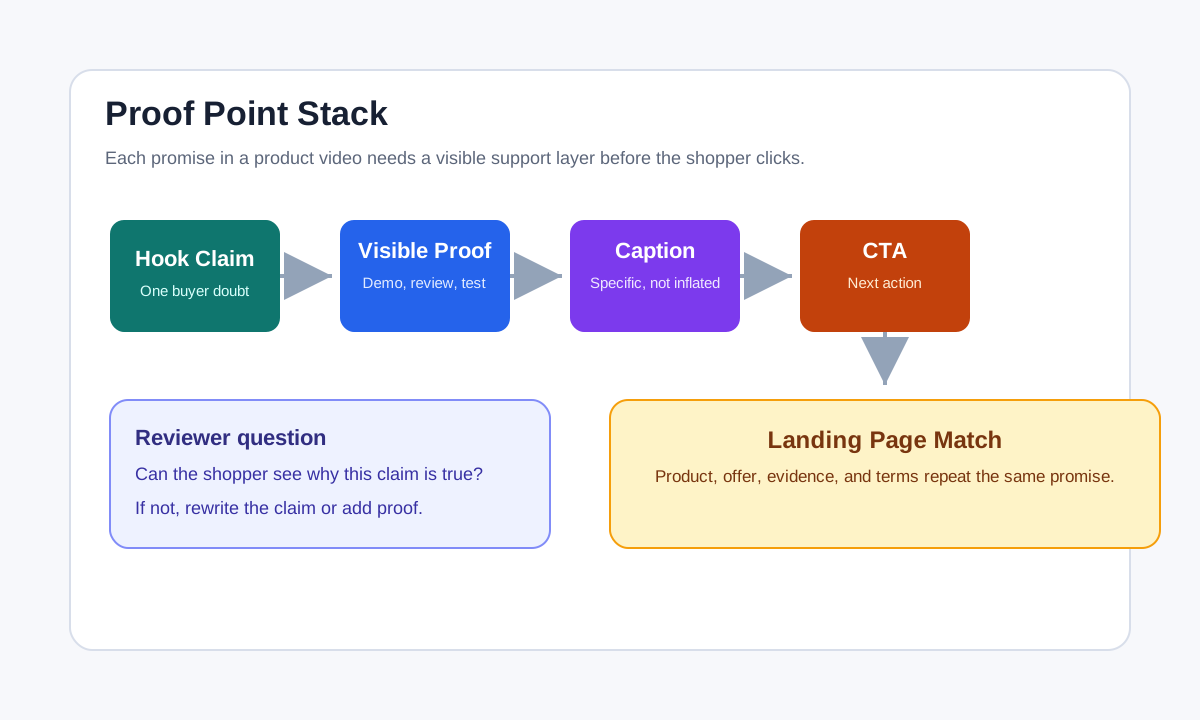
Product video proof points are the visible details that make an ecommerce ad believable: the product in use, a specific result, a real review, a side-by-side comparison, a test, a creator's context, or a matching offer on the landing page. A strong product video does not just claim a benefit. It shows enough proof for a shopper to understand why the claim is credible.
For ecommerce teams, the safest proof points are specific, visual, and easy to verify. Instead of saying "best cleaner ever," show the spill, the product, the wipe, the after shot, and the exact product page promise. Then connect that proof to a clear next step.
If you already use a product video script template, a storyboard template, or a product video compliance checklist, use this guide as the proof layer between the claim and the final edit.
What Counts as a Product Video Proof Point?
A product video proof point is any visual, audio, text, or landing-page element that supports the promise in the ad. It can be a product demo, close-up feature shot, review quote, creator use case, test result, before-after sequence, comparison frame, or proof-matched product page.
The key is that the proof must be tied to the claim. A pretty lifestyle shot is not proof if the ad says the product saves time. A five-star review is not proof if the hook promises a measurable performance result. A creator holding the product is not proof if the voiceover says it fixed a specific problem.
Good ecommerce proof points usually do three jobs:
- They make the product easy to understand in the first few seconds.
- They reduce the shopper's biggest doubt before the click.
- They keep the ad, product page, and offer consistent.
This matters across TikTok, Meta, YouTube, and product detail pages. Google's YouTube ABCDs framework emphasizes attention, branding, connection, and direction. TikTok's creative guidance emphasizes TikTok-first vertical creative, visible content, and people such as creators, employees, or customers. Meta's video guidance also pushes mobile-first, fast, attention-grabbing creative. Proof points are how ecommerce teams turn those platform principles into concrete product evidence.
The 7 Product Video Proof Points to Use
| Proof point | Best for | What to show | Risk to avoid |
|---|---|---|---|
| Product-in-use demo | Functional products, gadgets, home goods, beauty tools | The exact product solving one visible job | Showing a staged result the product cannot repeat |
| Before-after frame | Cleaning, styling, setup, organization, beauty, apparel | The starting state, product action, and final state | Implied typical results without context |
| Review or testimonial line | UGC, creator ads, retargeting, PDP videos | A real quote, rating context, or customer use case | Fake experience or missing sponsorship disclosure |
| Side-by-side comparison | Premium vs basic, old method vs new method | Two conditions with the same camera and rules | Unsubstantiated competitor or "best" claims |
| Close-up feature proof | Materials, fit, texture, size, assembly, ingredients | Macro detail, scale, included parts, compatibility | Over-polished AI visuals that distort the real product |
| Offer and destination proof | Sale ads, bundles, free shipping, limited drops | Price, bundle, deadline, product page match | Video promise differs from landing page terms |
| Stress test or QA check | Durability, battery, waterproofing, portability | A repeatable test and the pass standard | Extreme claims without evidence or legal review |
You do not need all seven proof points in one video. A 20-second ad usually needs one main proof point and one supporting proof point. For example, a product-in-use demo can pair with a landing-page offer check. A creator testimonial can pair with a close-up feature shot.
Proof Point 1: Product-in-Use Demo
A product-in-use demo is the strongest proof point for most ecommerce video ads because it answers the shopper's first question: "What does this actually do?"
The demo should start with a clear problem and a visible action. For a lint remover, show the fabric before use, the product touching the fabric, and the cleaned area. For a portable blender, show ingredients going in, the blend, the pour, and the final texture. For a skincare tool, show setup and usage steps without promising a medical result.
Use this structure:
- Show the product and the problem in the same frame.
- Show the product performing the action.
- Show the result without cutting away too soon.
- Add one short caption that describes the specific benefit.
- End with a landing-page or product-page next step.
The mistake is hiding the product behind a lifestyle scene. If the ad is for performance marketing, the first seconds should make the product role obvious. For more structure, build the scene from the product video shot list template before editing.
Proof Point 2: Before-After Frame
Before-after proof works because it compresses the buyer's problem and desired outcome into one visual. It is useful for cleaning products, organizers, apparel styling, hair tools, beauty accessories, desk gear, fitness accessories, and home improvement products.
Make the before-after frame credible:
- Keep lighting, angle, distance, and surface consistent.
- Label the before and after states plainly.
- Do not imply a typical result if the result is exceptional.
- Show the product action between the two states, not only the final image.
- Avoid medical, body, or sensitive-category promises unless reviewed.
The best version is not a magic trick. It is a short process: before state, product use, after state, and clear limitation. A caption like "30-second setup demo" is usually safer and more useful than "instant transformation."
Proof Point 3: Review or Testimonial Line
Reviews are powerful proof points because they answer trust questions that product specs cannot. But they need careful handling. If the review is real, keep the wording faithful. If a creator is paid, gifted, whitelisted, or affiliated, disclosure should be visible enough for the viewer to understand the relationship.
Use testimonial proof when the claim is about user experience:
| Use case | Strong proof line | Weak proof line |
|---|---|---|
| Comfort product | "I wore it for a 40-minute commute and the strap did not dig in." | "This is life-changing." |
| Kitchen gadget | "It fits under my cabinet and rinses in two parts." | "Everyone needs this." |
| Beauty tool | "The brush head is small enough for my lower lash line." | "Perfect results instantly." |
| Pet product | "My 22 lb dog fits in the medium size with room to turn." | "Best pet carrier ever." |
Specificity makes the testimonial useful. It also makes the ad easier to approve because the team can map the line to a real experience, a product fact, or an approved claim.
Proof Point 4: Side-by-Side Comparison
Comparison proof works when shoppers are choosing between the old way and the new way. It can compare a manual process with the product, a compact version with a bulky setup, or two product variants from the same brand.
The cleanest comparison is usually "old method vs this product" rather than "our product beats a named competitor." Competitor claims can be valid, but they require stronger evidence and more careful wording.
Use a fair comparison setup:
- Same camera angle.
- Same lighting.
- Same task.
- Same time window.
- Same amount of product.
- Same result standard.
For a product video ad, the comparison should make one point. Do not compare price, speed, durability, design, and reviews in the same 15-second cut. Choose the doubt that blocks purchase and prove that one thing.
Proof Point 5: Close-Up Feature Proof
Close-up proof is useful when the buyer cares about material, texture, size, included parts, ingredients, compatibility, or fit. It is especially important for products that look similar in a thumbnail.
Examples:
- Show stitching and zipper movement for a bag.
- Show scale next to a hand, phone, or countertop object.
- Show the inside of an organizer, not only the closed exterior.
- Show the product next to the device it fits.
- Show ingredient texture, applicator shape, or included accessories.
Close-up shots also help AI-assisted videos. If the generated video gives the product a premium look but hides real details, add close-up frames from real product assets or approved renderings. Product accuracy is part of proof.
Pair this with the product video overlay text examples so captions identify the detail without covering the thing the shopper needs to inspect.
Proof Point 6: Offer and Destination Proof
Some ads fail not because the creative is weak, but because the proof stops at the click. If the video says "bundle deal," the landing page should show the bundle. If the ad says "ships from the US," the product page should support that. If the ad says "50% off," the destination should not make the shopper hunt for the coupon.
Use a simple offer proof check:
| Video claim | Landing page must confirm | Fix if it does not match |
|---|---|---|
| "Buy one, get one today" | Eligible SKU, date, quantity rules | Change ad to "See current bundle offer" |
| "Free shipping" | Minimum order, region, shipping terms | Add terms in caption or remove claim |
| "Fits iPhone 16 Pro" | Compatibility list | Show exact model support in page copy |
| "Back in stock" | Product availability | Remove urgency if inventory is unstable |
| "2-minute setup" | Setup steps or demo proof | Say "quick setup" unless timed evidence exists |
This is where proof points overlap with compliance. Use the product video compliance checklist before launch if the offer, discount, or claim has changed since the first script.
Proof Point 7: Stress Test or QA Check
Stress tests are useful for durability, water resistance, portability, battery, packaging, fit, and assembly. They work best when the test is modest and repeatable.
A good stress test says:
- What was tested.
- How it was tested.
- What the pass standard was.
- What the result means for normal use.
A risky stress test says:
- "Indestructible."
- "Waterproof" without the correct rating.
- "Works forever."
- "Guaranteed to survive anything."
- "Lab tested" with no lab, method, or report.
If you cannot explain the method in one caption, the claim may be too broad for a short ad. Turn the result into a narrower proof point: "Survived a packed gym bag test" is clearer than "built for anything."
A Practical Workflow for Building Proof Into the Edit
Use this workflow before exporting the first paid version:
- Write the main claim in one sentence.
- Choose one primary proof point that supports that claim.
- Choose one secondary proof point for trust or destination match.
- Put the proof in the first half of the video.
- Add captions that describe the proof without exaggerating it.
- Check that product visuals match the real SKU.
- Check that the landing page repeats the same product, offer, and proof.
- Create two variants by changing the hook or proof order, not the claim itself.
- Review the final video with the compliance checklist before upload.
- Save the proof source beside the final file.
This keeps creative testing clean. If version A uses a demo and version B uses a review, you can learn which proof type moves the metric. If every variant changes the claim, hook, proof, offer, and CTA at the same time, the test will not tell you what worked.
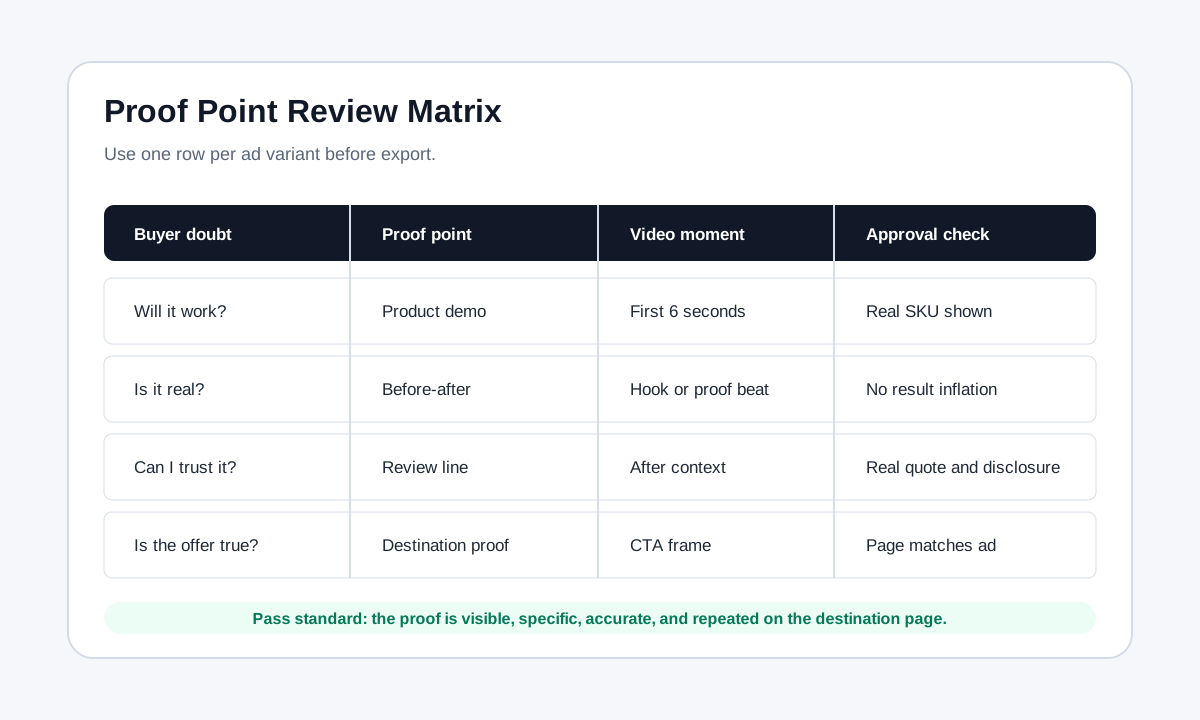
Proof Point Selection Matrix
| Buyer doubt | Best proof point | Suggested video moment | Useful internal guide |
|---|---|---|---|
| "Will it work for my use case?" | Product-in-use demo | First 3-6 seconds | Product video script template |
| "Is the result real?" | Before-after frame | Hook or mid-video proof | Product video storyboard template |
| "Can I trust this brand?" | Review or testimonial line | After product context | UGC usage rights checklist |
| "How is it different?" | Side-by-side comparison | Middle section | Product video examples |
| "What exactly do I get?" | Close-up feature proof | Product detail section | Product video captions guide |
| "Is the offer real?" | Offer and destination proof | CTA frame | Product video CTA examples |
| "Will it hold up?" | Stress test or QA check | Proof section before CTA | Product video compliance checklist |
How ShopShot Users Can Apply This
When you generate ecommerce product videos with ShopShot's AI video generator, treat the product page, product photos, reviews, and approved claims as the proof source. The AI draft can create scenes quickly, but the final ad still needs proof selection.
A practical ShopShot workflow looks like this:
- Paste the product page or upload product photos.
- Pick the buyer doubt you want the ad to answer.
- Choose one proof point from this guide.
- Generate a first cut.
- Replace vague captions with proof-specific lines.
- Export versions for TikTok Shop, Meta, YouTube Shorts, or Shopify PDP use.
- Check the final cut against the landing page and platform specs.
For a TikTok Shop product, the proof point may be a creator-style demo plus product link match. For a Shopify PDP video, it may be close-up feature proof plus setup steps. For a Meta retargeting ad, it may be a review line plus a clear offer.
Common Proof Point Mistakes
Avoid these patterns:
- Opening with a logo before showing the product or problem.
- Showing a result without showing the product action.
- Using a review quote that is too vague to answer a buyer doubt.
- Adding "best," "guaranteed," or "instant" when the proof only supports a softer claim.
- Using AI-enhanced scenes that make the product look different from the real item.
- Reusing a TikTok proof style on YouTube or Meta without checking format, safe zones, or caption readability.
- Linking to a landing page that does not repeat the offer or product detail from the ad.
The goal is not to make every product video over-explained. The goal is to make every promise earn its place.
FAQ
How many proof points should a product video ad include?
Use one primary proof point and one supporting proof point for most short ecommerce ads. A 15-30 second video usually becomes confusing if it tries to prove too many things at once.
Are customer reviews enough proof for paid ads?
Reviews are useful proof for experience claims, but they are not a substitute for evidence on performance, health, savings, durability, or comparison claims. Match the proof type to the claim type.
Where should proof appear in the video?
Put the first proof point early, ideally in the first half of the video. If the hook makes a claim, the proof should arrive quickly enough that the viewer does not feel tricked.
Can AI-generated product videos use proof points?
Yes, but the proof still needs to be accurate. Check that AI scenes preserve product size, shape, texture, use context, and claims. Add real close-up assets or approved product footage when details matter.
What is the easiest proof point to start with?
Start with a product-in-use demo. It works for most ecommerce categories, helps viewers understand the product quickly, and gives you clear footage to repurpose into platform-specific cuts.
Sources Checked
- Google Business: ABCDs of effective video ads, checked July 9, 2026, for YouTube ad creative principles.
- Google Ads Help: Show your products with your video ads, checked July 9, 2026, for product feed and video ad destination context.
- TikTok Business Help Center: Creative best practices for performance ads, checked July 9, 2026, for vertical, visible, creator-led creative guidance.
- TikTok Business Help Center: Best practices for Video Shopping Ads with TikTok Shop, checked July 9, 2026, for TikTok Shop video shopping context.
- Meta for Business: Best Practices for Video Creative on Facebook, checked July 9, 2026, for mobile video creative guidance.
- FTC: Advertising and Marketing, checked July 9, 2026, for claim substantiation and truthful advertising principles.